Showing posts with label medicine. Show all posts

Sunday, August 10, 2014

Third Reich from the Sun: Nazis, Space Medicine, and The Habitable Zone


Oh yeah… You read that right.
The Nazis.
Space medicine.
And the Circumstellar Habitable Zone.
What do all three of these things have in common?
One brilliant German physiologist’s tarnished reputation. His name was Hubertus Strughold, and he was truly a remarkable man. Today at To Infinity and…In Theory we’re going to talk about this World War II doctor of the Luftwaffe, Operation Paperclip (swear to God, actual name), the beginnings of Space Medicine, and something else.
Oh yeah.
The Habitable Zone.
The Habitable Zone is where we live, Earth. We’re just the right distance from our sun to meet all the requirements to sustain life. But if extremophiles have taught us anything in recent years it’s that the requirements for life may be a little more bendable then we initially led ourselves to believe.
But the Habitable Zone isn’t just important because of Earth, which would be narcissistic to say at best. Turns out, there are billions of planets out there that may meet the requirements to sustain life of some kind. Even rogue planets may experience enough tidal heating to maintain an atmospheric pressure suitable. Our entire way of thinking may have to shift in the search for life..
But before we get too far ahead of ourselves, let’s strap on our combat boots and climb down into the trenches of WWII with Hubertus Strughold.

The Führer of Space Medicine
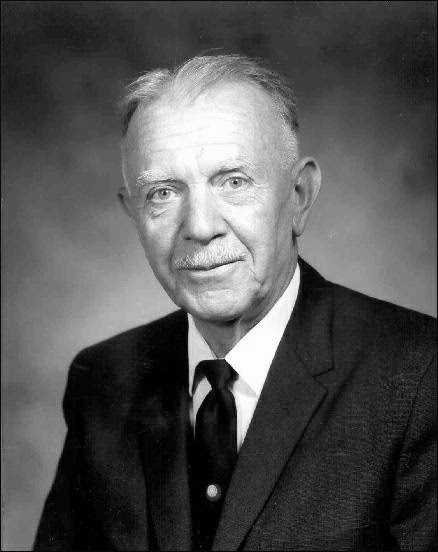

Here at To Infinity and…In Theory we like to laugh, however…if Monty Python taught us anything it’s that Nazis just aren’t that funny.


So, being that Nazis aren’t funny, you’re probably wondering why I’m making jokes about Dr. Strughold. Well, let me clarify this for you then. I’m making jokes because…drum roll please…
Yep, you guessed it. Hubertus Strughold wasn’t a Nazi.
He was a high ranking medical officer for the Luftwaffe however, which was the German Infantry. Basically, he just worked for the Army…but I can totally see how you’d get those two mixed up… (Kidding…sarcasm…actually can’t believe people get those mixed up…). Several of his assistants and pupils had gone on to work for the Nazi regime however, and before the start of the war Strughold had correspondence with Joseph Goebbels, a high ranking SS officer.
But saying because he knew one psychopath would be akin to saying that because you went to high school with Charles Manson you’re going to grow up to be part of his celebrity killing cult.
Needless to say a brilliant man’s reputation has been tarnished, and brilliant he was indeed. His research during World War II propelled modern aeronautics medicine ahead by decades. I won’t go into the details of the people performing the experimentation processes, but they studied oxygen deprivation and hypothermia amongst other things.
At the end of the war Hubertus found himself on the losing side in an appalling war. I firmly believe he had nothing to do with the Nazi war machine or the abhorrent nature of the Nazis’ atrocities, but that is just one man’s humbly earnest opinion. Needless to say however he had a unique skill set, and Uncle Sam wasn’t one to overlook talent. Hubertus Strughold found himself amongst 1,500 or so odd German doctors, scientists, engineers, and technicians that were immigrated to the United States to work on various projects through a program titled “Operation Paperclip”.


If you’ve seen the Shamwow infomercial you know, “The Germans build good stuff!” Despite the fact the endorser on the advertisement strikes me as a strange fellow and slightly daft he makes a good point. The Germans are well known for building products that are…well, good. They make them to last, and keep great records. Even as a doctor Hubertus was no slouch at sciences in general, which made him an invaluable asset. Good thing they snagged him up in the draft too, because he went on to achieve some truly great things.
He was the first to figure out what the effects of space would be on a human being by overseeing the construction of the Space Cabin Simulator and supervising the testing. He also designed the pressure suit and life support systems used onboard the Apollo missions, without Strughold, we’d have never beat the Russian’s to the moon!
Strughold was investigated extensively by the Department of Justice, and since he was found clean every time, was allowed to continue his work with NASA and the United States government. Hubertus was awarded dual citizenship in the late 50’s and an award was established in his name in 1962. What was the award for you ask? Space medicine. He is known as the Father of Space Medicine after all.
Anyone who advanced the field of space medicine significantly was given the Hubertus Strughold award. It was presented by the Aerospace Medical Association. Every year since 1963 the award has been presented, and a prestigious one it is, but in 2013, due to his tepid past, the Hubertus Strughold award was suspended. It still has not been confirmed as to whether or not it will be brought back. Personally, I hope it will. It isn’t fair to ruin someone’s reputation with slander


. But that didn’t stop him from making major contributions to our space programs and to the medical field in general. I have no need to discuss what happens to your body when it’s exposed to space; from oxygen deprivation to genetic mutations the publication IFLScience.com has a wonderfully written article all about it. You can read that here. In short, they wouldn’t know all that if it wasn’t for Hubertus…and Nazis unfortunately…but not a Nazi Hubertus!
Make sense?
Heaven to Betsy I hope so.
Anyway, it wasn’t just space medicine and alleged war crimes that Hubertus showed a propensity for. He was also, (like almost every scientist who ever existed before him) a bit of a philosopher. He wrote a treatise on physiology in space titled The Green and the Red Planet: A Physiological Study of the Possibility of Life on Mars and in it used the words “ecosphere” and referenced various “zones” in which life could possibly propagate in relation to distance from a star.
While his arguments weren’t exactly grounded in Astrobiological Science, he raised some good points. Which is why shortly after he wrote it in 1953, an American Astronomer took strong interest in it, because unlike Hubertus, he could apply the missing puzzle pieces of the Science that Hubertus had overlooked.
He called it “Liquid Water Belt theory”, and that’s what we’re going to talk about next.

“You Are ‘Here’”


In 1953, Harlow Shapley took Strughold’s theory a step further by making it plausible. He proposed what was then called “Liquid Belt Theory”. In his theory he surmises that given what we knew about the sun, and what we knew about life on Earth and it’s necessity for water, that only planets within a certain “range” of their star would be able to support liquid water at its surface. Therefore, only these planets would be able to sustain life. Sounds like wild conjecture right?
Except for the fact that Shapley was already well beyond qualified to answer these questions. How was he qualified you ask? Well in 1920 he was able to correctly postulate our position in the Milky Way Galaxy and our sun’s relation to it. Long before the technology even existed to correctly just “guess” that kind of thing. The man was a genius.
What was exceptional about him though is that had one known Shapley in his youth, they never would have guessed his massive intellect. He had dropped out of school in the 5th grade, and later, when he applied to a high school, he and his brothers were denied as being “unprepared”. Instead they attended a parochial school, received a diploma, and by 1910, when Harlow was only twenty-five, he received his B.A. with high honors in mathematics and physics.
Not bad for a grade school dropout, eh? A year later he received his Masters and was recommended for the prestigious fellowship offered by Princeton for his remarkable achievements. During his fellowship he disproved the age old theory of Cepheid stars being binaries. It would not be the last time Cepheid’s would be studied and revised however, but his contributions to it were the most tremendous since 1784, when Edward Pigott first proposed it.
So why were the ecosphere and the liquid belt theory so important? Because they became the key components of our next subject. The Circumstellar Habitable Zone.

Goldilocks and the Three Suns


Ecosphere, Biosphere, Hydrosphere, call it whatever you want, but at the end of the day, it’s the golden area of opportunity for life to exist called the Habitable Zone. Colloquially called “The Goldilocks Zone” by some researchers, this area of hospitality in the fundamentally harsh regions of space has been tossed and turned by scientists for decades.
Certain stars burn at certain temperatures. Red dwarf stars tend to be cooler than our medium sized yellow one. Blue stars are thought to burn the hottest. Then you get into Orange, White, and Brown dwarfs, and blah, blah, blah. There’s a dozen or so odd star types, but for our purposes, we’re going to talk about suns that are actually life sustainable.
As you can see from the picture above the areas that are red around each star are the hottest and are deemed inhospitable for life to exist. But if extremophiles here on Earth have taught us anything it’s that life can exist in the most unforgiving environments. (Remember our four part spotlight on Extremophiles? Catch up here! Part One, Part Two, Part Three, Part Four)
So while these zones may not be able to sustain human life as we know it, it could certainly maintain Methanotrophic bacteria, such as the ones that thrive at the bottom of the Marianas trench, or maybe some of the Cryophiles that survive in the depths of Lake Vostok beneath Antarctica. Our understanding of “life as we know it” has shifted drastically in the last decade.
But even cooler still are the planets that can support our kind of life. Humans. Those are the ones that scientists are most interested in. We should all be interested in them too, because we’re quickly destroying our current one, and we may be long overdue already for a reset button.
So where are some of these planets capable of supporting life of some kind? Let’s go all Guardians of the Galaxy…


…and do a little exoplanetary exploration of our own. Also, just as a quick disclaimer, the photos in the accompanying sections of the exoplanets are just artists’ representations (like that amazing concept art above!) and not photographs, still, enjoy!

HD 85512 b


HD 85512 b finds itself nested in the Vela constellation about 36 light-years from our planet. It’s a super-Earth, being that its mass is almost four times bigger than our own. Through the High Accuracy Radial velocity Planet Searcher (HARPS) program in Switzerland, HD 85512 b was discovered to be flying within the habitable zone and this one could potentially contain liquid water at its surface.
But this one isn’t the only potential candidate for life support abilities. HD 85512 b so far is thought to be one of best, but so isn’t the next one on our list.

Gliese 581 d


Unlike HD 85512 (The Sun of the planet we just talked about) which is an Orange Dwarf, Gliese 581 d orbits a Red Dwarf. According to scientists it would have a dark and murky atmosphere with twice the gravity of Earth. Initially thought to have been tidally locked, this giant with seven times the mass of our planet, has been rethought extensively. Now it’s believed that Gliese 581 d has a dense Co2 atmosphere, meaning it could trap heat well and maintain liquid water on the surface.
The drinkability of that water is questionable and the distance is over twenty light-years from us making this a far off candidate for the distant future. But what about the next one on our list?

Gliese 581 g (or is it??)


Nothing will bring you to the verge of an existential quandary faster than people questioning your existence, (or your status…I miss Pluto…), but that’s exactly what’s happening to 581 g in the Gliese 581 orbit. He orbits the habitable zone, has the potential to harbor liquid water at its surface, maybe even be a better candidate than his brother, but there’s one problem…
They don’t even know if he exists…
Poor Gliese 581 g. Unlike him, we’re certain of the next one, discovered as a part of the Kepler program.

Kepler 186 f


If you thought that HD and Gliese were a long distance off, you were sadly mistaken. Those systems are right around the corner in comparison to the 490 light-years between us and Kepler 186 f. Recently discovered this year back in April, it is only a mere 10% larger than Earth and is the closest planet to Earth in size ever found in a habitable zone.
This is a huge deal. Not only does that mean Kepler 186 f can sustain life as we know it scientists are saying that life could even thrive on its surface. Its system is set up a lot like ours as well, with multiple planets too far away from or too close to their star to sustain life. Unfortunately, its great distance means tremendous strides will have to be made in telescoping technology in order for us to get a close up glimpse of its surface.

Kepler 22 b


But if you thought Kepler 186 was a ways out there, Kepler 22 b is here to tell you that’s just a skip across the pond. At a whopping 600 light-years from us, this Earth 2.0 planet discovered in 2010 was initially thought to be the end-all for the search. With an estimated surface temperature of 72 degree F, Kepler 22 b is more than capable of sustaining liquid water. However, given its distance, that’s probably all we’re really going to know about him for a while.

HD 40307 g
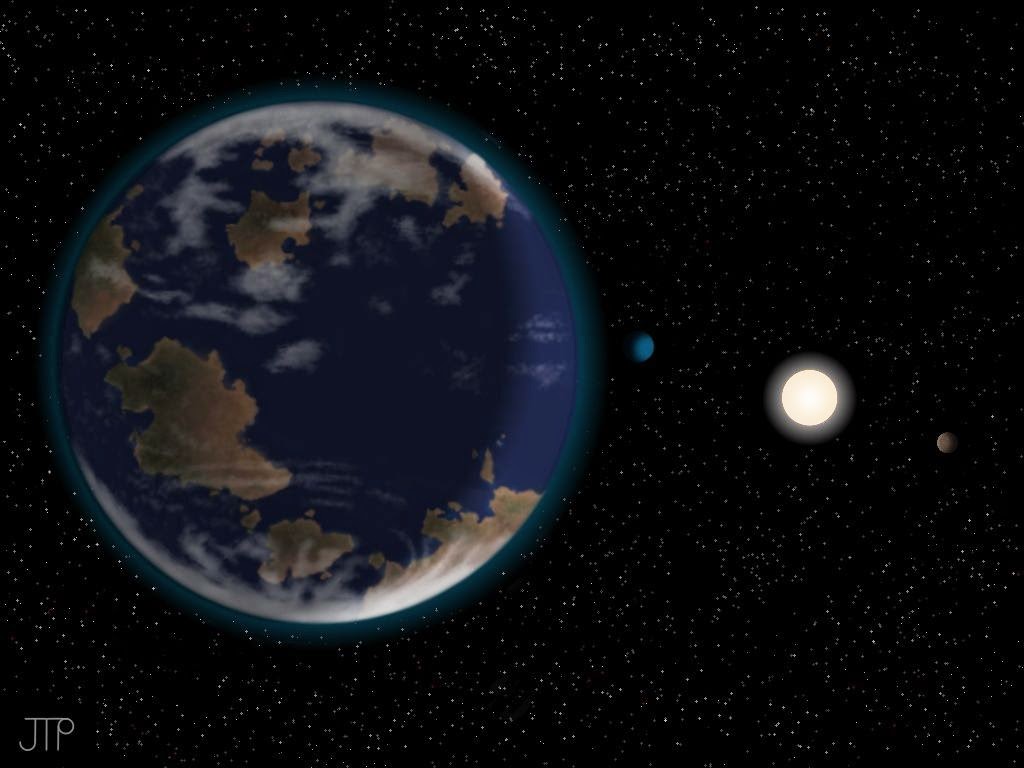


Located a measly 44 light-years away, this Super-Duper mega-sized Earth could hold seven of our little blue balls inside of it. With a length of year slightly half that of ours and a distance of 40 million miles closer to its star, HD 40307 g finds himself right smack in the habitable zone.
Because of its relative closeness to us, next generation telescopes are thought to be able to peer at its surface. Perhaps within a decade we may actually be able to catch a glimpse of life on another planet.

Tau Ceti e


The last one on our list today is the unconfirmed planet Tau Ceti e. The strangest thing about this planet is the fact that it’s unconfirmed when it’s the closest one on our list at only 11 light-years from our sun. Should the confirmation come about however this could prove gigantic to the scientific community, because not only would the surface of the planet be close enough to take snapshots of in a few years, but being in our own “cosmic backyard” could mean Tau Ceti would become the target of future interstellar missions.
Take that Orson Scott Card. No more 3 millennium long trips.
All jokes aside every planet on this list, and many, many more just like them, could prove once and for all that we’re not alone out there in the galaxy. Now the real question is…
Do they even want to meet us?

-       Ryan Sanders


Thanks for reading! As always if you would like to know more feel free to follow any of the links below! Share this around on Twitter, Facebook, Reddit or wherever else Social Media takes you, and be sure to head over to Facebook and give the To Infinity and In Theory page a big thumbs up! Happy Learning everyone!

-       Wiki on Cepheid Stars
-       Wiki on HD 85512 b


Thursday, August 7, 2014

How Scared Should We Be of Ebola?


How scared should we be of Ebola?
That’s a loaded question if I ever heard one.
The truth is, it depends where you live. People in Sierra Leone should probably be more afraid of Ebola than people in Seattle. The problem is, when the media gets ahold of something like a virus with no known cure that only rears its retroactive head once every 20 years, things can go a little…dare I say…wonky?
Personally, I’m not afraid of Ebola. Certainly it would be awful should I contract the disease but what am I going to do about it? There’s no definitive cure for the malady and the only options are certain death and miraculous recovery, the latter of which is rare as a politician with a soul.  
But should you be afraid of it?
Once again…depends.
Today at To Infinity and…In Theory we’re going to talk about a topic that’s been flooding the news. Ebola. We’ll discuss the history of its origin, the virus itself, what several arguably insanely brilliant Zairian doctors did to help move along research during its last epidemic, some possible methods scientists are looking into as cures, and finally, the question everyone has been worried sick over…
Should we fear Ebola?
Let’s head on over to the unluckiest continent on planet Earth, and see if we can’t demystify some of the facts about this nasty bugger. We’ll answer the big question first. Where did this disease come from? And why don’t we know very much about it?

Welcome to Zaire


The first recorded case of Ebola was out of Zaire, Africa in 1976. By the time aid workers arrived there though, the virus had already run its course. There was nothing to really study, most of the victims had already died or managed to pull through. All that was left was the disposal of contaminated corpses. The only reason the first outbreak was quelled was because the village elders of the areas wised up and disbanded funeral rights in favor of mass burials. In their culture a funeral involved the people handling the corpse, which as we now know, is a method for the disease to find new hosts. The Zairians were unwittingly spreading it the whole time.
When the morning bell tolled 280 had been reported dead, 318 infected in Zaire. The bordering country of Sudan also felt the sting of the disease in 1976 as well. 284 people were affected by the syndrome and 151 were reported dead in the aftermath of that incident. But it was all over…well…not exactly.
Throughout the coming years there would be reported cases of Ebola circulating worldwide, from the Philippines, to Italy, and even here in the U.S. However, the mortality rate of these reports remained at 0% with less than a trillionth of the populous even experiencing symptoms in each of the aforementioned regions. In other words, less than ten total worldwide in between African outbreaks. And most of these cases involved primates. But then in 1994 and 1995 all hell broke loose once more.


Between the fall of ‘94 and the fall of ‘96, Gabon which borders the Congo was struck. Initially the symptoms were thought to be that of Yellow Fever, a disease which is a common ailment in the area. People began returning home from gold-mining camps sick as the dickens and there was nothing doctors could seem to do to treat them. By the seeming end of the outbreak only 31 were dead and 52 had been afflicted. Thankfully this outbreak had been smaller than Zaire’s…
But Zaire wasn’t done yet…
Remember I mentioned this is the twenty year sickness? It’s not a literal term, more of a moniker doled out by the News of the time, but it’s fitting, because almost twenty years after the first outbreak of Zaire in 1976, in 1995 it happened again. A hospital in Kikwit performed a medical procedure on a patient carrying Ebola Hemorrhagic Fever. They didn’t know unfortunately, and spread it throughout the hospital. The next Zairian apocalypse began.


This time the CDC (Center for Disease Control) and the WHO (World Health Organization) were on top of things. They immediately dispatched doctors from all corners of the world including Switzerland, France, and the United States. This time they were in the thick of the pandemic. That’s good for everyone. Right?
Eh…depends…
It’s all a matter of perspective really. If you watch the documentary Nova made in the ‘90’s called “Plague Fighters” it might change the way you see things. During the course of the outbreak the foreign pathogen experts encountered…dare I say, cultural barriers?
Africa wasn’t exactly known for its high level of education at that point in its history. Almost the entirety of the population was illiterate which made spreading information about controlling contamination factors exceedingly difficult. There was no radio, television, or internet. The only way to spread it was word of mouth or through posters such as these ones below:


But most couldn’t read it. And when people were told to report their sick and dying to foreigners and men in suits and masks they were terrified. Think about it. How would you feel if someone who didn’t even speak your language came to your house and said your grandma had to go with them because she was sick? I’m sure you’d feel more than reluctant to relinquish her to them wouldn’t you? I would. And that’s what was happening. Villagers who couldn’t read the signs didn’t understand the seriousness of the situation and by the time they did it was far too late.


With a mortality rate of 79%, in the wake of this tragedy 315 were infected from onset and 250 were dead. Scientists spent their time there trying to figure out the source of the outbreak. They finally traced it back to patient zero, Gaspard Menga. Everyday Gaspard would travel from his home Kikwit into the Foret Pont Mwembe. It was roughly an 18 mile journey for the man.
He would burn wood to charcoal and sell it for fuel. But in 1995 that was over when Gaspard fell ill and died. By the time they traced the disease back to him scientists from the WHO and the CDC Atlanta had a new goal. Find out where Ebola was hiding at when it wasn’t virulently decimating human populations.
It couldn’t be insects. Insects were literally everywhere in the region and if they were the carrier the disease would be much further reaching. Since most large game in the area had been hunted into extinction all that remained behind were small monkeys, rats, bats, and snakes that composed the diet of the indigenous people. None of these were found to be the source either. Scientists were baffled.
From 1976 until now they’re still uncertain of what the Ebola Virus progenitor is, but they have decided the most likely cause is bats. See bats are kind of sloppy, and their food chain has a trickle-down effect. They’ll drop partially eaten fruits and pulp which makes its way into plants that feed off the soil or into animals through direct contact. The disease is then thought to manifest within a new organism and mutate into a strain which can affect humans. This new strain is then passed off onto us through contact with the infected organism through consumption or through contact with their bodily fluids in some way.
See, trickle-down effect.
So why bats? Because they’re known to already carry a kissing cousin of the Ebola virus known as Marburg’s.
“What the H-E double hockey sticks is that?!?!”
Calm yourself.
It’s time to explain the virus.

“This Isn’t Even My Final Form”


The Ebola virus is a Filovirus, and luckily (so far at least) it seems it’s one of two in the family with a taste for human blood. The other members include Marburg’s virus, the recently (still being bickered over…) discovered Cuevavirus, and the Reston virus. Marburg has had about as rich of a history as Ebola has, however its infection rate has been much, much lower. Let’s talk about the taxonomy of that one virus first.
Marburg’s Virus is named after the place that suffered the initial outbreak. In 1967, German Scientists in a facility in Marburg were playing with infected monkeys. Somehow while handling the tissue the disease jumped hosts, infecting 31 people in total, seven of which died.
Marburg’s virus, like Ebola, is a hemorrhagic fever. It’s less virulent in us however, but to primates, it spells disaster. The other deadly murderer of monkeys is the Reston virus. In the 1980s a facility in Virginia, United States suffered an outbreak amongst its primate specimens. To avoid possible pandemic all the test subjects were euthanized in their cages and Hazmat teams disposed of the corpses.
So what do these viruses do? I won’t bore you with the tedious details surrounding their pathophysiology but I will give you the criteria to be included in the family of Filoviruses. First and foremost the disease has to ultimately gestate into a hemorrhagic fever. Secondly it needs to be able to infect pigs and bats within nature and exclusively replicate itself within the cytoplasm of a host cell.
Shape, size, and weight are factored in as well. But another key component of classification is the ability of the virus to adapt itself through serial passage from host to host. That is how diseases like Lloviu Virus (Cuevavirus) passes down from bats and manifests itself as Marburg’s or Reston’s within primates. That is how it is believed certain strains have adapted themselves to pass onto us in the form of Ebola.
Viruses don’t care about your political agenda.
They don’t care about your sexual preference, age, height, weight, gender, religious beliefs, or what your dreams and aspirations are. Viruses only care about one thing, replication and survival. That is why Ebola is classified as a Level-4 biohazard by the CDC and WHO and calls for Level-5 containment protocols. That is the highest either scale goes.
So now we know its history and what it is, only a few more questions remain. Next we’re going to talk about the current outbreak and how it’s being handled, signs and symptoms of the disease, and what parts of the world are currently being affected.

932 Souls and Counting


As you can see from that graph, since 1976 there hasn’t been an outbreak with a more significant death toll than the one we’re currently facing. As of the time of this writing on August 7th, 2014, the current death toll throughout the five or so nations afflicted has almost risen to 1,000 and the disease is still raging. Having just spread into the neighboring country of Nigeria, a closely knitted community of 21 million or so odd people, the crisis level has risen to response level 1 of all disease control agencies worldwide.
And it isn’t just the Congo for the first time being affected by this disease. United Kingdom and United States aid workers have been stricken with it, the head doctor of Ebola pathology in Sierra Leone died of the disease, and a man named Patrick Sawyer, a U.S. citizen, died under quarantine in Nigeria. Patients have been flown back to facilities in the United States for experimental treatment. The entire world is in a panic over this.
Which brings us to the initial question of the article.
Should you be scared of Ebola?
My answer, even after all of this, is still, depends.
Do you have an inordinately high fever? Does every muscle and joint in your body feel like its torn or ripped out of socket? Do you have a severe headache with extreme sensitivities to light and sound? Chills? Weakness? Nausea?
If so…ask yourself this question…
Have you come into contact recently with anyone who works with the WHO, CDC, or been on a business trip to Africa in the last six months? If so, get your *** down to the CDC, if not, then kindly get off of WebMD, take two Excedrin and a nap, you’re probably hung-over.
The disease can rear its head anywhere from 2 to 21 days after infection. Usually in the course of a few weeks you’re either dead or getting better. The later symptoms of the disorder include vomiting, bloody stools, red sclera (The white area of the eye), chest pain and horrible coughing fits, stomach pain, extreme emaciation from vomiting and inability to ingest foods, internal bleeding, external bleeding from orifices (i.e. eyes, ears, nose, anus) and eventually death.
Let’s be real here for a second, you don’t even see side effects like that on American pharmaceuticals. Those are some horrible consequences and a truly horrific way for somebody to die. That’s why the fact that there is no known cure makes for such a panicky matter.
After the second major outbreak in Zaire occurred a man named Dr. William Close wrote a book entitled “Ebola”. When interviewed for the Nova documentary mentioned before he is quoted as saying, “We can no longer live in our isolationist state of thinking anymore. We are a small community of nations and when one coughs nobody sleeps.”
His words couldn’t ring more true, especially pertaining to this current crisis.
Agencies are banding together though in the name of humanity to try and find a cure for this disease. Scientists are racing round the clock to save as many lives as they can while aid workers do their best to quarantine areas of outbreaks and try to keep casualties minimized.
So what are some of these “cures” they’re working on? Let’s talk about those last here today.

Tobacco’s Got Yo’ Back


That’s right folks, you read that correctly. Tobacco it seems is the answer to the problem. Well…maybe not just tobacco, but a protein found within the cells of genetically modified tobacco plants. I know what you’re saying, “Uh oh, there’s the G M Oh no you didn’t word again.” Sorry to say this folks, but get used to GMOs, they’re here to stay.
That debate is for another day, but what isn’t up for debate are the beneficial effects this protein has been found to have on primate “participants” in the initial trials. The treatment is called ZMapp, and it’s what was given to two U.S. aid workers who contracted Ebola while working in Liberia. As of two days ago, reports were circulating the internet about their improvement, but so far, not many publications are willing to cite ZMapp as the cure.
So what is it?
The tobacco plants are what are known as bioreactor plants. They’re encoded with a specific gene that enables the production of antibodies against a certain pathogen. Once exposed to the disease, the plants produce the antibodies in large quantities to fend it off, once this has happened the scientists harvest the proteins responsible for warding off the illness and culture it into a serum that can then be used to inoculate people against it or even cure those who are afflicted.
We’ve done things like this for a long time. Remember Alexander Fleming? (No not the guy who wrote James Bond, that’s Sir Ian Fleming, but nice try…) Alexander Fleming discovered penicillin. How did he do it you ask? Accidentally, but he was using bacteria to culture proteins that could be distilled into an antivirus. What about the production of synthetic insulin? We encode E. Coli bacterium with the insulin producing gene and harvest them.
Further trials will be needed, and I’m sure given the virulence of this pathogen the CDC and WHO may be willing to move ahead with human trials using volunteers. I know for a fact that, while I’m not worried about contracting Ebola considering where I live in the world, if I did get it, I would sign up for that trial in a heartbeat.
Wouldn’t you?

-       Ryan Sanders


Thanks for reading! If you enjoyed the article feel free to share it around on Facebook, Twitter, and Reddit, don’t forget to head over to the To Infinity and…In Theory Facebook page and give us a like, follow us on Twitter @ToInf_InTheory, and give this article a thumbs up if you learned something today! For further reading follow any of the links below and have a wonderful and safe Ebola free day! Happy Learning!

-       Wiki on Reston Virus
-       Wiki on Marburg’s
-       Wiki on Lloviu Virus
-       Wiki on Filoviruses
-       Wiki on Ebola Virus