Showing posts with label Climate Change. Show all posts

Tuesday, August 5, 2014

Don't Believe In Mass Extinction? Neither Did These Guys...


We’ve talked about the importance of biodiversity here at To Infinity and…In Theory before, (Livin’ Life to the Extremophile: Biodiversity [Part 4]), but never like this. In fact, scientists are worried that our dwindling levels of biodiversity on our planet may be leading us down the treacherous path toward our sixth mass extinction.
Some of you may be thinking, “What the heck is a mass extinction?” I assure you, it’s just as terrifying as it sounds, because for once, the word extinction seems to be apposite to us, humans, homo-sapiens, your mom and dad, brothers and sisters, it applies to everyone this time. And if we don’t do something to change the course of current events – something as drastic as the changes we’ve made that struck us out on this awful road – we’re going to go the way of dinosaurs.


So how do scientists know this is coming? From reading and interpreting the Earth’s fossil record. The fossil record is a detailed analysis of the planet’s history, taking us all the way back to its inception and through every period in which life almost ceased entirely. Today at TI&IT we’re going to talk about extinction, fossil records, explain a little about evolution (and give some proof humans are still evolving), and we’ll finish up with a short list of some of the species you’ll never get a chance to see up close because of our direct involvement.
Let’s talk a little bit about how a species goes extinct first.

Acid Rain, Super Volcanoes, and Meteoroids…Oh My


Be it multiple continent sized asteroids that pelted the Earth, erupting super volcanoes, shifting fault-lines, or acid rain, there are a hundred different theories on what wiped the etch-a-sketch of life on Earth clean five times prior to the emergence of our first ancestors. There is one thing scientists are sure of though, the temperature of the Earth rose, similarly to what is happening now.
The fossil record, which is a collection of the organisms we have excavated from the Earth over the centuries and igneous rock contained within the Earth, is like a documentary of the World. Using methods similar to Carbon Dating (we’ve talked about that before too: How To Politely Ask A Mummies Age) scientists can pin down what was abundant in the environment and what minerals and gases were almost non-existent.
By searching the area around where dinosaur bones are exhumed for radioactive isotopes with an excessively long half-life (Uranium-238, Potassium-40, etc.) researchers can build a blueprint of what was abundant in the atmosphere before we even came into being. This technique has been used to prove the age of the Earth and the Moon. (A whopping 4.5 billion years for both, talk about a geriatric!)
But the fossil record isn’t just dinosaurs and rock collections. Ice samples and other geological phenomenon are factored into it as well. Researchers recently in Great Britain at the Universities of York and Leeds decided it was time to take another look at the fossil record. Perhaps it would lead them to a better understanding of what was causing huge numbers of fauna to drop dead on our planet all of a sudden.
What they found is disturbing to say the least.
Turns out, if they’re findings are correct, a cold effect may be more beneficial for life on Earth than a warm sunny one. It’s called “The Icehouse Effect” and it’s the topic of our next section.

The Fridge of Life


We’ve all heard of the Greenhouse effect, but what’s the Icehouse effect? Well, it’s the opposite of the Greenhouse or Hothouse effects to be exact, but we’re going to break down the differences a little bit further. The Greenhouse effect occurs when there is an abundance of greenhouse gases in our atmosphere, such as methane, Co2, and CFCs. These gases cause the atmosphere to heat up, trapping UV radiation within the ozone layer and melting polar ice sheets.
The Icehouse effect is the exact opposite. Greenhouse gases like Co2 are relatively low in the atmosphere, allowing dangerous radiation and superheating factors to escape our little bubble, keeping the surface of the Earth cool. It seems that after analyzing fossil records, researchers came to one huge conclusion.
Life on Earth thrived during Icehouse periods.
During Greenhouse periods…well…not so much…
We know that humans are a major producer of Carbon Dioxide and methane gases through our destructive burning of fossil fuels and excessive expansion and deforestation methods, but if humans and Hondas weren’t around 4.5 billion years ago, what caused the temperature to rise?

O-No-Zone You Didn’t!


There are quite a few theories as to how the Earth rapidly heated itself up and cooled down as we mentioned before. The most viable theory however is that of heightened volcanic activity. It’s no secret the plates inside the Earth’s crust shift, that’s how we went from one big supercontinent to the seven different continents we have today. But what people don’t realize is that when continents drift apart, things can get ugly.
Think of it like this. As tectonic plates shift and move it is literally ripping the Earth apart in order to create new landmasses. As these plates shift and move it generates an earthquake, these can range in magnitude, but any earthquake can spell bad news. This increase in tectonic shifting caused hundreds of volcanoes all across the surface of the Earth to erupt.
When volcanoes erupt they can spew thousands of tons of debris and detritus from within. But it isn’t just solid matter being released from volcanoes. Volcanoes spit out superheated gases as well, chief amongst them being Carbon Dioxide. Too much of that spills into the atmosphere and we begin running into hitches and snags.
It gets to a point where plants can’t absorb the influx of gas coming in and convert it to oxygen fast enough. The gases get trapped in the ozone layer and bounce around, keeping harmful radiation from the sun from escaping back into space. When this happens temperatures begin to rise, polar ice caps begin to melt and a hothouse effect begins to take place.
This is just one theory.
Because the Earth has spent almost 80% of its existence in this greenhouse state it’s almost impossible to pinpoint the exact causes. When the planet heats up, ice shelves melt. When that happens habitats are lost. When habitats are lost the ecology of an area is disrupted. When the ecology of an area is disrupted, fauna begin to die. Once fauna begin to die, that’s when we’re in trouble. That’s when we begin to approach levels of mass extinction.
So if hot’s bad why is cold so good?

Keeping Current


As it turns out, the North and South Poles may be the key to keeping our current climate in check. Without the niche ecology they provide we wouldn’t have the diversity of life everywhere else. Let’s give an example shall we. The whale, possibly the largest creature currently on this planet, survives on a diet of some of the smallest organisms, plankton. They screen it off the surface with their large teeth in massive amounts. Yum.
Plankton is just one of many nutrients found in our oceans feeding its inhabitants. In colder climates, such as up by the poles, there are higher concentrations of nutrients in the water for plankton to thrive. Why? There’s less activity and less organisms to share the plankton with the whales in cold environments, so they absolutely love it!
So how does plankton end up in warmer climates? Glad you asked. The answer is, currents.
The currents carry the plankton to warmer waters. But if there aren’t variations in temperature between areas of the ocean there wouldn’t be currents. Obviously there are other factors that play into this as well, such as geological activity and astronomical values, but we aren’t talking about those today.
So do you get it now?
We’re in a greenhouse period currently.
Greenhouse = Bad.
Icehouse = Good.
So how do we fix this?
First of all the government should probably pull its collective set of heads out their Gluteus Maximus’ and (I can’t believe I’m saying this…but…) listen to Al Gore when he says climate change is upon us. And it’s bad.


Some animals have adapted over the millennia to survive these fluctuations. The Great White Shark is just one example of a killing machine that’s been here since the dawn of time. The Duck-Billed Platypus is another animal that’s been here since time immemorial, however, the Platty needed to, well, change a little bit over time.
Scientist’s call this evolution. And we’re still doing it too, just not at a rate nearly fast enough to outrun the damage we’ve caused. Don’t believe me that your physiology is changing a bit every day? Let’s lay that to rest next then.

Your Poké-Human is Evolving


We’ve changed a lot since our first days of stepping into the sun. Just one example of this is our ability to drink milk. We weren’t always designed that way. There is an enzyme in our body known as the LCT gene. Before the domestication of milk producing livestock (cows, goats, sheep, etc.) the gene would shut down in babies after being weaned off their mother’s breast milk.
People that are lactose intolerant never develop that gene. For another example we’ll turn to a piece of literature first. In Markus Zusak’s amazing novel “I Am The Messenger” a hapless protagonist named Ed has to help strangers at the behest of a mysterious individual sending him seemingly random addresses in the mail. One of these characters he encounters is a young girl named Sophie. Why is Sophie important to this article you ask? Because she possesses an interesting trait, she runs barefoot.
Early humans didn’t have Nike’s and Converse to toss on their feet while they ran away from hungry Tigers and Cheetahs. They ran barefoot, and as a result the muscles and tendons in the feet and lower legs developed accordingly. Even if you find well-fitted footwear it’s still unnatural to squeeze your digits into your Reebok’s and take off for a jog around the block. We had to evolve again in order to wear such constraining apparel.
Now these kinds of genetic mutations don’t just spring up overnight. DNA analysis of ancient farmers and herders all over the world shows that the ability to digest lactose carrying over into adolescence didn’t spring up until about 8,000 years ago throughout Europe and India. Running barefoot also took thousands of years to fade away. As I said, we’re evolving at a quick rate (according to paleoanthropologists anyway) but not nearly quick enough.
Just ask these guys…oh wait…you can’t…

The Way of the Dodo


Animals have been going extinct for millions of years. The dinosaurs are a classic example of this, but whenever people think of extinction that is unfortunately the first place they go. Well as it turns out, humans are responsible for causing extinctions as well. Just look at some of these examples below.


That’s the Formosan Clouded Leopard. You’ll notice that’s a fairly recent, high quality picture, not some pencil drawing from Charles Darwin’s sketchbook. That’s because the Clouded Leopard wasn’t officially declared extinct until last year in 2013. (They were really holding out hope for this one.)
Indigenous to Taiwan, this leopard was the second-largest carnivore. The Rukai (Taiwanese Aborigines) considered the hunting of these majestic creatures to be a taboo sin. So how were they pushed into extinction by us? Through the logging of their habitats. From 2000 to 2004 more than 13,000 camera traps were set up in their last known habitat but none were spotted in that four year period.
The last known Formosan Clouded Leopard was confirmed in 1986. None have been “spotted” since.


Yes, I agree. That is one truly, exceptionally, and wholly ugly bird. However, we shouldn’t have pushed the Mauritius Blue Pigeon into extinction just because of that. Remember last week when we talked about the Dutch and the spice trade? (Quick recap here: Why We Taste: A Brief History of “Thyme” and the Rest of Your Spice Rack). Well while they were sailing around the Mascarene Islands East of Madagascar, they encountered this comely looking plumage flying around above them. Only one live specimen was ever brought back to England, the rest were stuffed.
Like our friend the Clouded Leopard, the Mauritius Blue Pigeon suffered from his habitat being over logged and the wrath of hunters. This little fella was classified as extinct almost 200 years ago now between 1826 and 1830. (Dates vary depending on the source). Regardless of where in that four year period they disappeared from the face of the Earth one thing is still apparent, even their relatives, other Blue Pigeons, are at risk of fading away forever.


Another sad story in the annals of extinction is pictured above. The Tahitian Sandpiper was pushed into extinction in 1773 when rats were introduced into its habitat. As a result, not much scientific information is available on this little guy. Only one stuffed specimen is known to still exist. Five years before him this poor creature depicted below vanished as well:


That’s Steller’s Sea Cow, and what happened to him, well, I’ll tell you this much, it wasn’t very stellar. The largest of the Manatee family known to have shared the Earth with humans was hunted into extinction. Why? For their meat and the leather that could be produced from their hides. Humans are so awesome aren’t they? (Total sarcasm…) The last one of these rotund aquatic bovines was killed in 1768.


While there are literally over 100 examples of species that humans have shoved out of the picture, for the sake of time the last one we’ll talk about today is the Mexican Grizzly Bear. Considered a close relative of the Brown Bear, this was the largest land mammal that roamed the hillsides of Mexico. The last one was shot and killed in 1960. That was just over 50 years ago. The Black Rhino was also officially declared extinct last year, so we’re still doing it.
So there you have it. In this modern world it’s quickly becoming one of evolve or die. And if we don’t do something about our rapidly changing climate, we won’t have time to do anything but the latter. If you want to read more about species we’ve shoved off the cliff you can by visiting this comprehensive timeline over at Wikipedia by clicking here. Thanks for reading everyone, and remember…
It’s not just hipster Dodo that thinks existence is too mainstream.
Soon, our planet could feel that way about us too…

-       Ryan Sanders


Thanks for reading everyone! As always feel free to share this around on Twitter, Reddit, Facebook, wherever you think the news needs to go! Conservation is extremely important! If you would like to know more about any of the topics discussed above today feel free to follow any of the links below! Happy Learning everyone!


Monday, July 28, 2014

Deadly Waters: The Killer Beneath Lake Kivu


We’ve all seen the disaster films. “Armageddon” taught us that all we need is Bruce Willis and a rag tag team of oil riggers to save us from a meteor-related extinction. “The Core” showed us what happened if our planet stopped spinning, (and we learned a valuable lesson about not playing with Earthquake machines.) Other films like “The Day After Tomorrow” depict a frozen wasteland or “Waterworld” in which all the ice caps have melted and we’re completely submerged (epic foreshadowing Congress…)
But what happens when lakes start killing people?
While it’s probably not going to make a blockbuster appearance at the box office any time soon, the reality of Limnic Eruptions, also referred to as Lake Overturn, is a very real, and very deadly one. So how do lakes go about killing people? I’ll give you a hint, it’s not because people drown in them, and it isn’t disease hiding in the water. Turns out, there’s something even more deadly lurking deep down below.
Today at TI&IT we’re going to talk about Lake Overturn, and two natural disasters in the early and mid-1980s that gave us great insight into this destructive phenomenon. We’ll also talk about one lake that, if it were to explode, would kill over 2.2 million people in process and the procedure for eliminating this issue. We’ll also briefly touch on some of the other locations where we can find similar situations throughout the world.
But first, let’s talk about where this indiscriminate killer has already left his mark. And to do that, we need to travel to Africa. Specifically, Cameroon, to a small lake called Monoun. This is where the noxious assailant first made his appearance, in the form of an innocuous, little white cloud.

That Ain’t Casper


See that mass of white accumulated at the bottom of the lake in the photo above? No, that isn’t from some factories smokestack. It also isn’t a reflection of light off the lake. It’s something far more sinister.


No…it’s not Casper the Friendly Ghost either… It’s a noxious gas; well, maybe not as toxic as you might think. We actually expel it every time we draw in a fresh breath.
It’s carbon dioxide.
But in 1984, in Cameroon, that little white cloud was responsible for the death of 38 people bordering the lake. How did this happen you ask? Well, we may exhale Carbon Dioxide, but that’s just the thing, we get rid of it. When exposed to it in massive quantities, Carbon Dioxide can completely displace the air due to its heavier density, effectively choking out the oxygen in the environment around us. In 1984, that’s exactly what happened. While the villagers slept, the Co2 sunk over the ridges of the mountains above and moved slowly through the village, displacing the air and asphyxiating everyone.
But this was just a shadow of the dangers to come. Two years later in 1986, a similar event not far away would dwarf the tragedy of Lake Monoun in every way imaginable. On August 21st, Lake Nyos spewed a gigantic cloud of gas upward from its depths. The cloud crept over the villages surrounding the lake while the people slept. By morning, roughly 1,800 people were dead, stifled of air in their sleep. Livestock lay dead all over the roads and the countryside.
Fear and panic swept through the area. Everything from chemical attacks to angry Gods was thrown out as a possibility for the mysterious deaths occurring around the lakes. Villagers had reported seeing the white cloud moving across the lakes. In the aftermath of the Nyos tragedy there were only six survivors, and they had suffered peculiar “burns” all over their bodies. These lesions were highly inconsistent with anything people had seen before.


These “burns” would only make sense if the Co2 had been superheated, but seeing as the corpses of the other victims showed no signs of scalding trauma this theory held little weight. It would take a team of brilliant researchers, and a radical new theory, to explain the tragedies at Nyos and Monoun.
Good thing the world had both of those up its sleeve.

Nyos’ Secret Volcano Lair


After the incident at Monoun a group of researchers led by Scientist J.C. Sabroux took to the waters to find out just what had occurred. They paddled out the center of its surprisingly calm waters and began lowering their equipment in. Basically the tools used were tubes with openings used to gather samples from the deepest sections of the lake, but as they drew the tubes to the surface something strange was happening, gas bubbles were rising up ahead of the equipment, making the surface look like the surface of a carbonated beverage.
The bottom of the lake was filled with Co2, this didn’t make any sense to the researchers until they realized something. They were sitting on a volcano. Volcanoes are well known for their violent history of erupting various hot gases into the atmosphere, chief amongst them being Sulphur and Carbon Dioxide.


 There was just one problem, this lake hadn’t erupted. In fact, seismographs would indicate this volcano wasn’t even all that active. So how was this Co2 getting to the surface? Turns out the volcano was just venting.
Just because the volcano doesn’t have any active plans to decimate the village below doesn’t mean it doesn’t have to let off some steam. Through underground vents called Chimneys, the volcano sends the gas upward to the surface where it mixes with ground water. As the ground water mixes with the lake water the gas is intermixed as well and sinks to the bottom. The Chimneys also directly feed the lake from below as well and the high pressures of the great depths keep it trapped at the bottom.
Until an Earthquake does something like causes a rock slide to send tons of heavy and dense material crashing down to the depths. As we all know from freshman year Earth Science class, when we drop dense materials into a glass of water it displaces it. And if you drop a rock into something carbonated (like a Coca-Cola for instance) it causes the Co2 to get riled up and rise to the top of the glass.


So when the rock slide sent those stones crashing into the water and to the bottom, it stirred up the Carbon Dioxide. Excited, it rose to the surface and formed a cloud, killing the villagers. The ones it didn’t kill suffered burns consistent with overexposure to carbon monoxide. What ended up happening was when the gas shut their bodies down it stopped circulating blood to the skin first. As a result the skin cells began to die and blistered up.
Now there are a lot of lakes that contain gases throughout the world. What made Nyos and Monoun so special? Well they were Meromictic Lakes, which means they were stratified, they didn’t intermix. Allow me to explain this a bit further.
Most lakes throughout the world are Holomictic or Polymictic. What this means is that through certain means these lakes stir themselves up to re-oxygenate the water at deeper levels. Wind is a good example of this, as it pushes along the surface of the water it stirs it up aiding in current flows, this causes the lake to turn itself over, preventing gas buildup.
Another method for lakes turning themselves over is temperature shifts. Optimally at 4 degrees above freezing (32 degrees F) the water on the top will sink to the bottom because it’s now heavier than the much warmer water below. This is why during winter months fish tend to school around the bottom of lakes, the water there is more oxygen rich. The warmer water rises to the top to start the process over again.
Tropical lakes like Nyos and Monoun are calm and warm year round and don’t receive the benefits of Polymictic lakes. As a result, dangerous gas buildups can occur. In 1987, Sabroux and his team announced their findings to the world, coining for the first time, the term “Lake Overturn.”
So now that they knew what the problem was, how the heck do they fix it?

Degassing: Like Xantac For Lakes!


 So if the waters of Monoun and Nyos don’t intermix and instead remain stationary year round how do we fix the problem? Quite simple really. They installed a series of pipes throughout the lake that reach the bottommost section of the waters, hook them up to a pump, and manually vent the water to the surface. The Co2 rich water at the bottom is forced safely up through the series of pipes. Once it reaches the surface the gas is released into the air in harmless amounts and the water cascades back down to the lake.
A lake of Monoun’s size only needs one or two of these pipes to not only keep it at safe levels but within a course of five years, almost completely eliminate the gas. Nyos will cost more money however being that it’s much larger and requires six to eight pipes to accomplish the same feat.
But what about the deadly giant Lake Kivu near Rwanda?
Kivu is roughly 2,000 times the size of Nyos and should it decide to go through a Limnic Eruption (Lake Overturn) it would take the bordering population (around 2.2 million people) with it. And there’s an even bigger problem still. Lake Kivu is host to an even deadlier monster at its depths.
Just above the layer of Carbon Dioxide at the bottom is another gas, Methane. Those of you familiar with chemistry know that Methane creates an even bigger problem than Co2, because unlike Carbon Dioxide, Methane is explosive. It’s a fossil fuel; in fact, Bralirwa Brewery in Rwanda along Lake Kivu has been using this naturally occurring fuel to fire its equipment since 1963.


Unfortunately, while this is genius, it doesn’t chip away at the methane content fast enough to bring it down to safe levels. International efforts are underway to fund a project which will harvest the methane from the lake to be used as a fuel source. Venting the Co2 will undergo a process like Nyos and Monoun, but Kivu will be far more costly because of its size.
Whatever they choose to do and however they choose to do it, it needs to be done soon. In the early 2000’s a volcano bordering Kivu erupted sending molten magma pouring into the lake. Had the lava reached the layer containing the methane it’s likely a highly explosive reaction would have occurred and the entire population along the lake would have been killed. Case in point:


Still don’t believe me? Fine, don’t take my word for it. But you should certainly listen to the distinguished Professor Robert Hecky. When he was working for the University of Michigan in the United States he had core samples drilled from the deepest parts of the lake and his findings were disturbing. It turns out every 5,000 years or so the gas buildup gets so great that a Limnic Eruption is inevitable, and we’re just about due.
The good news is that since the breaking of this news, the scientific community and energy entrepreneurs worldwide have been chipping in to get at the methane below the bio-line of Lake Kivu. With any luck a violent eruption like the ones seen in the distant past won’t occur in Rwanda again.
And that’s great news. Because personally, I think they’ve had enough bad luck.

So…You Said There’s More of These…?


I did, and they are located all over the world. However, not all of them produce gas levels like Kivu, Nyos, and Monoun. As a result, while they don’t turn over, they don’t pose a threat to the populations in the surrounding areas. From Lake Vanda in Antarctica:


To Jellyfish Lake in Palau on the Asian continent:


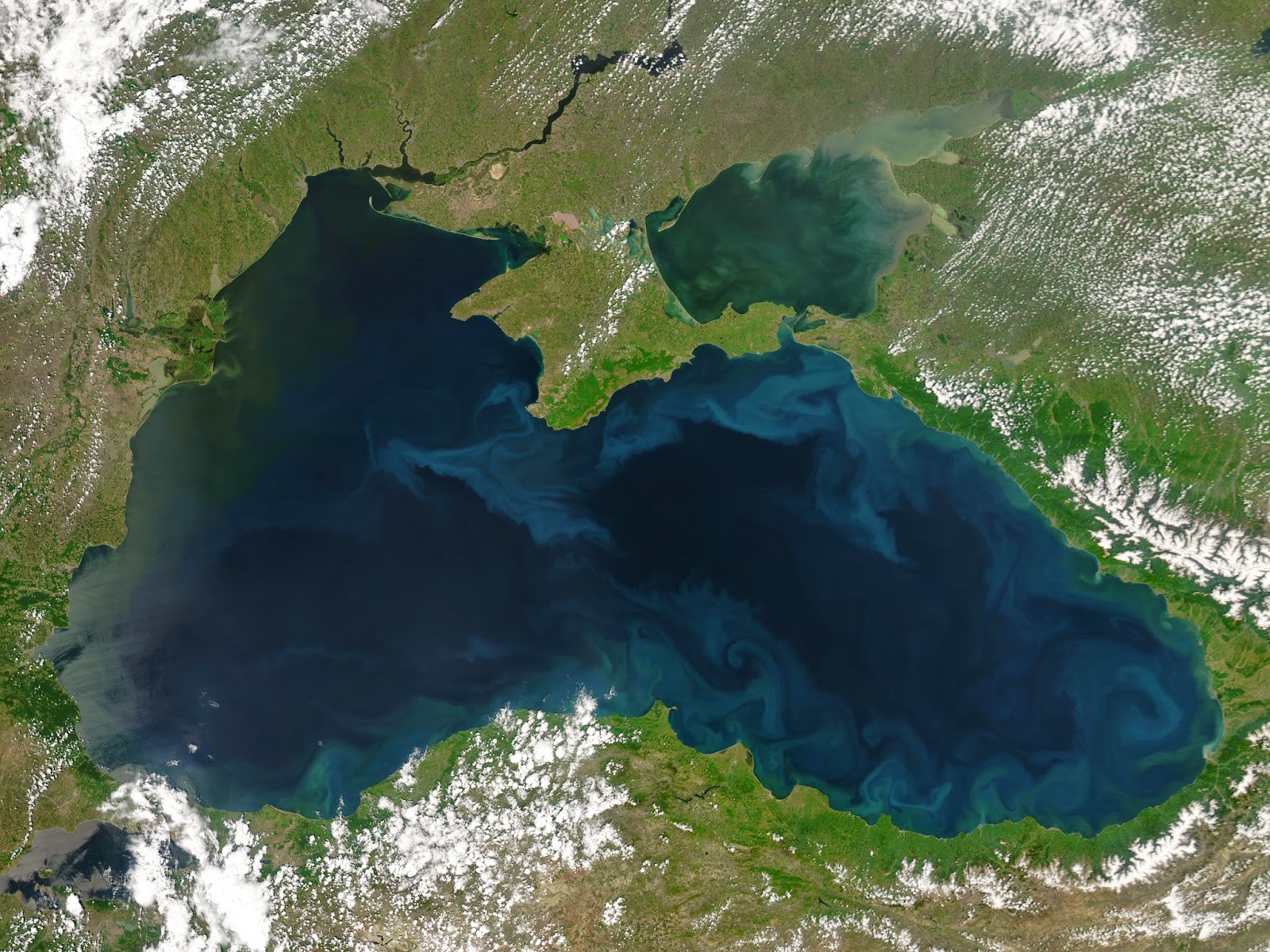
Even The Black Sea, bordering the countries Russia, Romania, the Ukraine, Georgia,      and Turkey is considered to be Meromictic:


But don’t fret. If you live on the border of any of these lakes or other Meromictic ones you needn’t worry. As I said above, these don’t contain the gases necessary to provide the devastating effects Kivu is capable of. If you want to see more Meromictic lakes check out the Wiki by clicking here.
Thanks for reading everyone!

-       Ryan Sanders


Thanks for reading everyone! Hope you enjoyed the article today! If you want to read more about any of the topics discussed above feel free to follow any of the links below. Don’t forget to share this around on Twitter, Facebook, Tumblr, Reddit, whatever other social media exists nowadays that I don’t know about yet! You’re continued support is what keeps me doing this! Thanks again everyone!

-       PBS blog on lake Kivu


Tuesday, May 27, 2014

Climatology Be Dammed: Cleaning Up Hydro-Power


Cold snaps, heat waves, rolling black outs, droughts, floods, pictures of floating polar bears. Seems like climatology is on the tip of everyone’s tongue these days. It didn’t always used to be like that. I remember a time when people would laugh in your face when you told them the black smoke coming from the back of their Diesel powered Super Truck was actually bad for the environment.
Ha ha, yeah…I also remember when smoking was supposed to make you look cool too.
I’m not saying run out and buy a pack of Marlboro’s, what I am saying is you should pay more attention to the environment. And no that doesn’t mean you have to run out and buy a Prius, stop eating meat, and only wipe your posterior region with 100% recycled T.P., but it does mean you should start paying a little closer attention.
While climate change probably won’t actually cause the entire melting of the polar ice caps or the middle of the globe to spontaneously combust, it does have the potential to make life here very volatile and quite difficult for us. What we really need are ways to fix it, to right the damage we have already done. But how? Where do we start?
By cleaning up our messes first and foremost. We need to admit some of our “green” technology isn’t as clean as we would like it to be. Earlier last week, the Israeli people showed us how they made a desert bloom (To Make A Desert Bloom) by coming together and working as one. They showed us when an ecology is damaged we can fix it. So why don’t we rip a page from their script and break down exactly what it is I’m talking about.
This week at TI&IT we’re going to discuss climate change, starting with the biggest offenders, the greenhouse gases. We’re going to talk about natural and unnatural ways these are dispersed within the environment. We’re also going to talk about hydroelectric power and why this is actually a major contributing factor, and we’re going to talk about how to move forward with our energy demands in order to cut down our Carbon footprint.
Let’s start with the biggest question you’re probably all asking right now. Just what’s up with that pretty looking gem in the picture above?

Hydro-Problems? Just Barium


The ocean is a dangerous place for single-celled organisms. On the surface of the ocean is this material known as phytoplankton. It’s basically a collection of microscopic plant like material, and this tiny substance forms the key to the delicate ecosystem of oceanic life. Animals big and small, from whales to starfish, rely on phytoplankton for their dietary needs.
Sometimes phytoplankton doesn’t get consumed however; sometimes it just runs its lifecycle and dies. When this happens it begins to sink and bacteria in the ocean take over breaking it down. As a byproduct of the breakdown a mineral known as barite (Barium Sulphate) is produced.
Barite is used in drilling fluid, rubber manufacturing, and certain cements. It’s widely varied colorful spectrum and geometric formations are highly sought after by collectors. But there is another thing about Barite that is extremely important to note, something that makes it worth discussing in detail in this article today.
It may contain the key to telling us how we can fix our runaway climate.
But before we analyze a solution, it’s paramount that we understand the problem.

The Great Greenhouse Trap-osphere


That’s exactly right Admiral Ackbar! The atmosphere works like a giant bowl that traps the greenhouse gases within its shell. Unless these unpredictable molecules punch holes in our humble defenses and break through they wreak havoc in other ways, namely by making our summer’s a little hotter.


Greenhouse gases are naturally given off as byproducts of the environment. Carbon Dioxide for example, the gas you exhale after your lungs have consumed all the oxygen after each breath. The trees and other flora on the planet use this gas to produce energy for themselves, but not all of it gets captured by plants. Some of it has always risen to the top of our atmosphere and gets trapped by what’s known as the ozone layer. The sun bounces off of these gas and water molecules creating the illusion of a blue sky but more importantly warming the planet for us less hairy bipeds.
So if these gases are produced naturally why should we be worried? Well because we produce a significant amount more than the environment has ever given off as a byproduct through natural means. Through various human activities we have increased the amount of greenhouse gases in the atmosphere at an exponential rate, because of this we could be approaching another period of time that Al Gore has been complaining about for decades.
In the words of rapper Nelly, “It’s gettin’ hot in here.”

Global Heat Stroke


Around 55 million years ago it seems the Earth went through a similar kind of issue. During the Paleocene-Eocene Thermal Maximum (Top right map) temperatures spiked dramatically and the Earth went through an extreme warming. The good news is that the bacteria and phytoplankton gobbled up the greenhouse gases and in a relatively short time were able to correct the runaway train.
The problem is a relatively short time is hundreds of thousands of years.
I don’t know how patient you are, but I know the average human being can’t wait thirteen seconds for their Facebook page to load, let alone a thousand years to stop burning to a crisp every time they step outside in July. While letting nature run its natural course may not stop the destructive patterns of mankind, a research team from the University of California, Santa Cruz in the United States are looking into this strange time period in our planet’s history.
Led by scientist Adina Paytan, the team measured how much Barite was present in 12 seafloor sediment cores from around the globe. When the bacterium produces the Barite it sinks to the ocean floor and forms into the sediment deposits. By examining the Barite from that era, they may be able to figure out how and what bacteria reversed this maniacal meteorology.
There are skeptics to this however. A geologist from UCLA is quoted as saying it’s “a really cool way to visualize these biogeochemical processes,” but she questions the assumption that the oceans of today work like the oceans of yore. 56 million years ago the temperatures in the oceans were much warmer, creating a more proficient environment for bacteria to do their thing. As the waters gradually cooled bacteria production slows down, that’s just how things work.
Even if they found a way to slow down on Carbon Dioxide there’s a bigger threat creeping out of every rock and crevice on the planet. We expel it on a regular basis from our bodies, so do our livestock. It’s found at the bottom of ocean coming out of the vents, even found to comprise the atmosphere of celestial bodies in our solar system.
I’m talking of course about methane.

Silent But Deadly


That’s right. Flatulence is becoming a leading cause of global warming, so stop farting America!
Actually that’s only partly true. The Methane gas given off as a byproduct of flatulence is what’s contributing, and it isn’t because our diet has made us a little gassier. It’s actually because of the gases we’re displacing within the rock of our planet as we go about our destructive patterns.
Methane is produced by a process called Methanogenesis. The organisms responsible are called Methanogens (go figure.) As they break down organic biomass this is the final product given off as a result. The good news is there are organisms known as extremophiles out there that are Methanotrophic meaning that they consume the methane gas and convert it into less harmful byproducts more easily broken down by the natural processes of the Earth.
But like Carbon Dioxide not all Methane is captured and consumed. This excess methane is trapped within the crust of the Earth as organic material decomposes into the soil. When the area around the methane pocket is disturbed it’s nothing for the gas to seep to the surface. What disturbs the surface you ask?
Fracking. Mining. Building.
In short. Humans.
Methanotrophs aren’t abundant enough to keep up with our gross overproduction of this greenhouse gas. And it isn’t just rocket powered cows and bacteria producing methane gas at alarming rates causing this problem, it’s what we’ve done to let the gaseous monster out of its beaker.
The problems we talked about above are just to name a few, but one coming under fire in recent years that’s considered to be a not so green approach anymore is what we’re going to talk about now. And I have just one thing to say…
…dam it.

From Babbling to Bubbling Brooks


This may surprise you, but it turns out clean hydro-power is a dirty business. Aside from the fact that it abruptly disrupts the natural ecology of a region, dams can create another big problem, one that we’ve been talking about this entire time. Are you ready for it? Methane emissions.
When a region is flooded the entire community of flora on the flooded side of the dam is blocked in. This plant life begins to decay and sink to the bottom behind the dam. As it does it begins to block oxygen and light from reaching the organisms on the ground below. As a result, the organic material begins to decompose and form a methane pocket. When the turbines of the dam are turned on, the methane is released into the environment to cause heat waves the world over.
What’s worse is that it’s renewable. In areas known as “Drawdown regions” the water gets shallow as energy demand is increased and the dam begins to drain water. When this happens plant-life begins to recolonize the shorelines, but as soon as the dam is reflooded the cycle starts over again. These pockets of high methane production are known as “hot spots.”
Unlike Carbon Dioxide which is water soluble, methane can be released in two forms from underwater. Directly as a gas or trapped in bubbles. Until a recent study published by graduate student John Crawford out of the University of Wisconsin, these methane bubbles weren’t being considered as a factor when budgeting the greenhouse gases.
Because rivers and streams are constantly moving the water is consistently replenished with fresh oxygen. Where oxygen contents are high methane deposits are much more unlikely to form, same with sulfur or nitrogen, it just doesn’t play well with others. So for the longest time this important piece of the climate change puzzle was ignored.
Crawford can’t speak for the rest of the world but he has said the area in Wisconsin where he conducted his research definitely warrants more study, and he encourages the world over to do the same. With as many rivers, lakes, and streams that adorn this world, accurate measurements from each water source for methane contents and emissions may prove vital to understanding where we really need to cut back in our emissions.
So we’ve talked about methane and Co2, but what are some of the other offenders?

Ozone You Didn’t


Oh yes we did chemistry cat. Even though Carbon Dioxide and Methane are dangerous there are other greenhouse gases out there that make those two look like sissies on the scary scale. Co2 and CH4 are given off naturally and through agriculture, transportation, electricity, and many other means. But what about the ones that aren’t natural?
I’m talking of course about the heavy-weight champion of the molecular world, Chlorofluorocarbons, or CFCs for short. For the longest time CFC’s were referred to by their manufactured name of Freon. Freon was commonly used as a refrigerant for your kitchen appliance by the same moniker and air conditioners.
Unfortunately CFCs don’t break down very easily and they contribute to ozone depletion, or O3, more commonly known as the stuff that keeps our atmosphere in check. (And I sure do like my atmosphere.) So what do these molecular compounds do that is so bad?
Well first of all it’s a compound derived from the byproducts of our fossil fuel industry (yay!) so you know it has to be great. It’s made from a fusion of Carbon, Chlorine, and Fluorine. There is very little Chlorine in our atmosphere, and for good reason, it’s a noxious substance in its gaseous state to the human body. In fact it was outlawed to be used in weaponized form after the First World War due to its devastating effects on the human body, both short and long term.
Well once CFCs reach a certain height in the atmosphere the ultraviolet radiation from the sun finally breaks them down. The Chlorine is free and it’s finally allowed to start its rampage. It begins bouncing off of O3 molecules, knocking oxygen molecules free and slowly depleting the ozone. Let me explain it like this.
You got that one buddy that just can’t hold his liquor. He’s our CFC. You decide to throw a party for a friend who just got back from overseas. You guys all enjoy a good drink but nobody gets wild and crazy. The other guests are all O3 molecules. Nobody invites CFC but one guy who’s not too bright Tweets about the party and CFC shows up anyway, gets trashed, and sure enough all the guests decide it’s time to leave.
While ozone doesn’t have a consciousness to make those kinds of decisions it shouldn’t retract from the point that CFC is a dick.
Luckily as I mentioned above, for the most part CFCs have been phased out and replaced with HFCs that break down into Co2 which as we know is more easily broken down and doesn’t destroy the ozone layer. There are other ones too; Nitrous Oxide (laughing gas) and even water vapor contribute to greenhouse gases. Just take a look at the chart below.


While there is much debate over the actual numbers represented on that chart above one thing is certain; the environment is shifting polarity. If we don’t get on board, figure out what’s wrong with her, and fix it, it may not matter what kind of world we talk about leaving for our children.
They may not have a world left at all.

-Ryan Sanders


Thank you all for reading! As always if you want to know more about any of the topics we discussed above today you can by visiting any of the links below. Happy Learning everyone!