So,
to quickly recap. In the last 3 days we have traveled several miles below to
the Antarctic ice shelf to see what’s happening down there. We’ve visited the
deep and mysterious cave systems of Romania and Mexico. We’ve even braved the
icy cold depths of the Marianas Trench and stared through the looking glass at
planets a billion miles away! What else is there to cover?
The
wildlife of course.
You
didn’t think I was just going to leave you hanging did you?! To wrap up our
spotlight on Extremophiles and their unique habitats, it seems fitting that we
spend some time talking about the locals. Here are some of the most bizarre
creatures our planet has to offer, and what it means to the future of
exploration.

(Fig. 1)
The Olm, or Proteus. Note the lack of eyes and pigmentation
this is
due to its habitat where there is almost no light
The Caves
What
a strange looking creature right? That little guy picture above is called the
Olm, or the Proteus, and like the American mudpuppy, it’s one of a kind. It is
the only cave-dwelling Chordate that we are aware of at the time of this
writing, and it’s not just his bizarre looks that set him apart from the rest.
Dubbed
“Human Fish” in Slovenian by the local population this strange amphibian
evolved in the caves below Slovenia for centuries. It’s noted in the 1860s by
explorers but didn’t become a creature of study until most recently. It has
three toes on its front feet and two on the back. Why? Reduction. See, when Mother
Nature decides a creature no longer needs something to survive; it removes them
in favor of something more necessary.
Like
eyes for instance.
Because
the Olm is primarily aquatic and lives in the perpetual blackness of underground
cave systems the eyes have regressed over time, leaving the sockets covered in
a layer of skin. Essentially the Proteus is blind but it still retains
sensitivity to light. It has rudimentary lungs but these play second fiddle to
the brightly colored red gills he sports like flowers on either side of his
head. The reason these gills are so vibrant is because of the lack of
pigmentation in the little guy’s skin. Because the oxygen rich blood is red in
those areas, and the skin is practically transparent, you can see the bright coloration
clearly.
But
like a superhero this little guy sure can hear! Its other senses have strongly
developed over time, making up for its lack of sight. The Olm can live for
decades without food, sitting motionless on the floor of its watery home, but
unlike other aquatic animals that exhibit this kind of behavior, the Olm can
take off at blinding speeds at a moment’s notice whereas other creature’s out
there that slow down their metabolic functions are more slow-moving.
So
is this guy an Extremophile? I’d say so. While it doesn’t really live in
battery acid water or null-oxygen environments, its ability to survive up to
ten years on the lipids and sugars it manufactures in its liver I’d say put it
there.
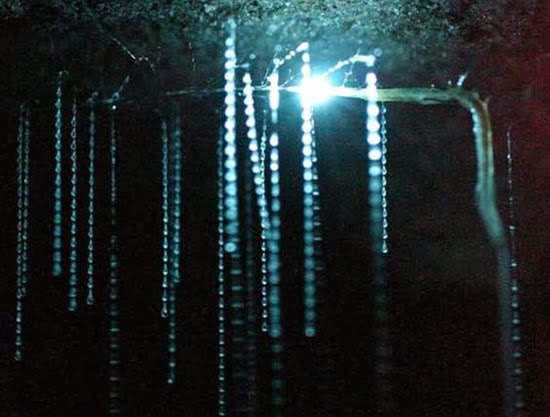
(Fig.
2) The glow-worms deadly web traps and the bioluminescent tail-
light of
a glow-worm in a New Zealand cave
See
that neat little light glowing there? Thought so. Ya, that’s the New Zealand
Glow Worm, that crazy little guy sure is bright isn’t he? Bioluminescence, a
process by which an organism exhibits light through production of a chemical in
an organ, isn’t extremely uncommon in extremophiles. It makes sense when you
think about it, most of these guys live in really dark environments, so it
doesn’t hurt to have a lamp sometimes.
See
those strings with what appear to be little beads of water accumulated on them?
Those aren’t strings, per se. They’re actually traps! The glow worm is carnivorous.
It traps other insects in the webs, like a spider’s actually, and then it sucks
their internal organs out via chemicals that cause their prey to liquefy.
Gnarly little fellas aren’t they? But it doesn’t stop there; there are more
files on this extremophile.
See,
the glow worm is a larval stage, and they’re kind of dumb. With their
over-territorial nature and lack of distinction they will actually cannibalize each
other if one roams into another’s territory. What’s even worse, when the fly
hatches from the larval form, it will often follow the lights of its larval
brothers, flying right into its own traps to be consumed. As I said, not very
bright.
In
its glowy worm stage of gestation the creature only has one goal. Eat and
convert that food into proteins. Eventually, when it has consumed enough it
will cocoon itself, much like a butterfly, that pupa eventually becomes the
fly.
From
the 31 unknown species they uncovered in Movile’s chemosynthesis based cave to
the strange and bizarre blind fish the villagers of Villa Luz depend on every
year there is peculiar life all around us. Next let’s see what they discovered
when they ventured down into the depths of the Ocean.
The Vents
For
the longest time scientists believed that the sun was the ultimate catalyst for
life on Earth. After all, it powered the microbes and the plants via
photosynthetic rays. This in turn allowed the plants to turn Carbon Dioxide
into useful oxygen for us, in turn creating the very atmosphere we need to
survive. The sun is pretty important, so it makes sense that we didn’t think life
could exist without it.
This
heliocentric view was nice, I mean, it wrapped everything up in a nice neat
little ball for scientists everywhere, the problem? It was wrong. Yes, the sun
is necessary for life on Earth to exist and without it we certainly wouldn’t be
here but it’s not vital for all life.
Life just needs energy, where it obtains that source of energy can be a
testament to the true sustainability of life. What ALVIN discovered in the
bottom of the Marianas Trench in the 70’s is still being heavily researched by
scientists today, but what made this hardy ecosystem able to adapt to the
extreme conditions found at the depths of the oceans?

(Fig.
3) Microbial Polyextremophile life around volcanic vents.
Marianas
Trench
Piezophile,
Thermophile, Extremophile, Polyextremophile, all these terms apply to this
dense microbial mat covering hydrothermal vents at the bottom of the oceans. At
the extreme depths of the trench the pressure is so high that if you were to
try to swim down without a specially developed pressurized suit you would most
assuredly be doomed to implode. Our bodies are not capable of producing the
external pressure to survive at these depths, but these little guys pictured
above, and many ichthyologic (fish) species can.
That’s
what a Piezophile is. An organism capable of exerting the outward pressure
necessary to not be crushed by forces pushing inward on it. But that’s not the
only incredible feature of creatures able to live at these depths. The waters
down there are usually very dark and cold, leading most predatory species to
rely on other senses in order to feed. Also, as I stated earlier the microbes
need some kind of energy to feed on as well. So what keeps those mats from
drying up and dying out?
Tectonic
plates and the core of planet to be exact. See, the bottom of the ocean is
littered with what we call hydrothermal vents. These openings in the Earth
basically spit out the superheated contents of the core, venting the pressure
so our planet doesn’t explode. Naturally the contents have to very hot, but the
pressure at these depths keep the water from reaching a vapor form (in other
words, boiling point cannot be achieved) but the end result is a superheated
area that can sustain the bacteria and other microbial organisms that have
learned to adapt to it. The Piezo-Hydro-Chemolithautorophic-Thermophilic guys
are so complex they are actually put into a category all their own.
The
Polyextremophile, which is an organism exhibiting more than one quality of a
standard extremophile. So you see now why these guys are still under such heavy
study? Problems arise however when trying to remove these creatures from their
native habitat. Changes in pressure, temperature, and chemical intakes cause
specimens to rapidly decay leaving us to study them where they lay. But that’s
not really such a bad thing, I mean, who doesn’t like a good swim?
Deep Waters
As
we stated above the deep ocean is home to many strange species indeed, these
areas that go miles below sea level where no light can reach are intensely cold
and heavily pressurized. We used to think life couldn’t exist down there; here
are some pictures so show just how wrong we were:

(Fig.4) Deep-sea Angler Fish

(Fig.
5) Deep-sea Angler Fish (Bioluminescent)

(Fig.6) The Mouthless Tube Worm

(Fig. 7) The Yeti Crab
So
you see, in places like Lake Vostok we have discovered life (Cryophiles) and in
the acidic waters of Yellowstone we have discovered entire ecosystems that we
never thought could exist (Acidophiles). That is why it so important we explore
every avenue for possible life. This is a growing field, every day we’re
discovering more and more about these strange creatures that share our world.
That
is what has made NASA so interested in all of this. If we can find life in
these places, that survive off the methods they do when everything on our
planet right now tells them they don’t even have to, imagine what we’ll find
out in space where things have to evolve without the luxury of a lush
atmosphere to fall back on evolutionarily. In the coming years the methods we
use to cleanly extract and study these organisms will be vital to the coming
mission on NASA’s and other space organizations rosters.
Are
we going to find life as diverse on these other planets and moons as we do in
the most unforgiving environments on our planet? I’m doubtful but I’d never
rule it out. If life can evolve from a single-celled organism here then what’s
to say it can’t there? The age of Anthropocentricism as at an end, now that we
know what we should be looking for.
I
don’t care who finds it, I just want it to be found. I firmly believe there is
life out there in places like Io, Titan, and Europa. The key to finding it is
locked away in these organisms right here that share this world with us. I’m just
glad we’re finally opening the lock.
-Ryan
Sanders

From “The Far Side” by the brilliant “Gary Larson”
Thank you all so much for reading this four part series I've put together. It took a lot of hard work and research to pull all of this together for you. I hope you've enjoyed it and come back in the future for more exploration into the wonderful world of science. Happy learning everyone!
-Sincerely,
Ryan Sanders


