Showing posts with label #Jupiter. Show all posts

Saturday, December 7, 2013

Livin' Life to the Extremophile: Biodiversity (Part 4)

So, to quickly recap. In the last 3 days we have traveled several miles below to the Antarctic ice shelf to see what’s happening down there. We’ve visited the deep and mysterious cave systems of Romania and Mexico. We’ve even braved the icy cold depths of the Marianas Trench and stared through the looking glass at planets a billion miles away! What else is there to cover?
The wildlife of course.

You didn’t think I was just going to leave you hanging did you?! To wrap up our spotlight on Extremophiles and their unique habitats, it seems fitting that we spend some time talking about the locals. Here are some of the most bizarre creatures our planet has to offer, and what it means to the future of exploration.

(Fig. 1) The Olm, or Proteus. Note the lack of eyes and pigmentation
this is due to its habitat where there is almost no light

The Caves

What a strange looking creature right? That little guy picture above is called the Olm, or the Proteus, and like the American mudpuppy, it’s one of a kind. It is the only cave-dwelling Chordate that we are aware of at the time of this writing, and it’s not just his bizarre looks that set him apart from the rest.
Dubbed “Human Fish” in Slovenian by the local population this strange amphibian evolved in the caves below Slovenia for centuries. It’s noted in the 1860s by explorers but didn’t become a creature of study until most recently. It has three toes on its front feet and two on the back. Why? Reduction. See, when Mother Nature decides a creature no longer needs something to survive; it removes them in favor of something more necessary.
Like eyes for instance.
Because the Olm is primarily aquatic and lives in the perpetual blackness of underground cave systems the eyes have regressed over time, leaving the sockets covered in a layer of skin. Essentially the Proteus is blind but it still retains sensitivity to light. It has rudimentary lungs but these play second fiddle to the brightly colored red gills he sports like flowers on either side of his head. The reason these gills are so vibrant is because of the lack of pigmentation in the little guy’s skin. Because the oxygen rich blood is red in those areas, and the skin is practically transparent, you can see the bright coloration clearly.
But like a superhero this little guy sure can hear! Its other senses have strongly developed over time, making up for its lack of sight. The Olm can live for decades without food, sitting motionless on the floor of its watery home, but unlike other aquatic animals that exhibit this kind of behavior, the Olm can take off at blinding speeds at a moment’s notice whereas other creature’s out there that slow down their metabolic functions are more slow-moving.
So is this guy an Extremophile? I’d say so. While it doesn’t really live in battery acid water or null-oxygen environments, its ability to survive up to ten years on the lipids and sugars it manufactures in its liver I’d say put it there.
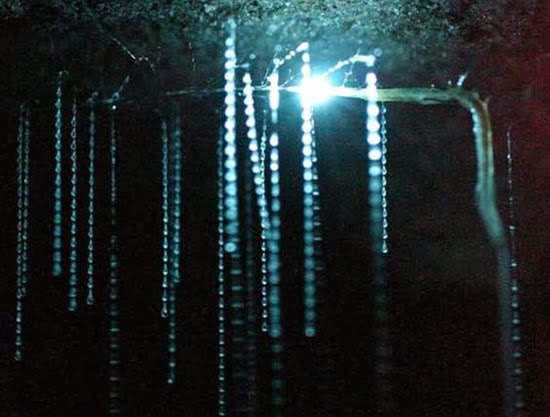
(Fig. 2) The glow-worms deadly web traps and the bioluminescent tail-
light of a glow-worm in a New Zealand cave

See that neat little light glowing there? Thought so. Ya, that’s the New Zealand Glow Worm, that crazy little guy sure is bright isn’t he? Bioluminescence, a process by which an organism exhibits light through production of a chemical in an organ, isn’t extremely uncommon in extremophiles. It makes sense when you think about it, most of these guys live in really dark environments, so it doesn’t hurt to have a lamp sometimes.
See those strings with what appear to be little beads of water accumulated on them? Those aren’t strings, per se. They’re actually traps! The glow worm is carnivorous. It traps other insects in the webs, like a spider’s actually, and then it sucks their internal organs out via chemicals that cause their prey to liquefy. Gnarly little fellas aren’t they? But it doesn’t stop there; there are more files on this extremophile.
See, the glow worm is a larval stage, and they’re kind of dumb. With their over-territorial nature and lack of distinction they will actually cannibalize each other if one roams into another’s territory. What’s even worse, when the fly hatches from the larval form, it will often follow the lights of its larval brothers, flying right into its own traps to be consumed. As I said, not very bright.
In its glowy worm stage of gestation the creature only has one goal. Eat and convert that food into proteins. Eventually, when it has consumed enough it will cocoon itself, much like a butterfly, that pupa eventually becomes the fly.

From the 31 unknown species they uncovered in Movile’s chemosynthesis based cave to the strange and bizarre blind fish the villagers of Villa Luz depend on every year there is peculiar life all around us. Next let’s see what they discovered when they ventured down into the depths of the Ocean.

The Vents

For the longest time scientists believed that the sun was the ultimate catalyst for life on Earth. After all, it powered the microbes and the plants via photosynthetic rays. This in turn allowed the plants to turn Carbon Dioxide into useful oxygen for us, in turn creating the very atmosphere we need to survive. The sun is pretty important, so it makes sense that we didn’t think life could exist without it.
This heliocentric view was nice, I mean, it wrapped everything up in a nice neat little ball for scientists everywhere, the problem? It was wrong. Yes, the sun is necessary for life on Earth to exist and without it we certainly wouldn’t be here but it’s not vital for all life. Life just needs energy, where it obtains that source of energy can be a testament to the true sustainability of life. What ALVIN discovered in the bottom of the Marianas Trench in the 70’s is still being heavily researched by scientists today, but what made this hardy ecosystem able to adapt to the extreme conditions found at the depths of the oceans?

(Fig. 3) Microbial Polyextremophile life around volcanic vents.
Marianas Trench


Piezophile, Thermophile, Extremophile, Polyextremophile, all these terms apply to this dense microbial mat covering hydrothermal vents at the bottom of the oceans. At the extreme depths of the trench the pressure is so high that if you were to try to swim down without a specially developed pressurized suit you would most assuredly be doomed to implode. Our bodies are not capable of producing the external pressure to survive at these depths, but these little guys pictured above, and many ichthyologic (fish) species can.
That’s what a Piezophile is. An organism capable of exerting the outward pressure necessary to not be crushed by forces pushing inward on it. But that’s not the only incredible feature of creatures able to live at these depths. The waters down there are usually very dark and cold, leading most predatory species to rely on other senses in order to feed. Also, as I stated earlier the microbes need some kind of energy to feed on as well. So what keeps those mats from drying up and dying out?
Tectonic plates and the core of planet to be exact. See, the bottom of the ocean is littered with what we call hydrothermal vents. These openings in the Earth basically spit out the superheated contents of the core, venting the pressure so our planet doesn’t explode. Naturally the contents have to very hot, but the pressure at these depths keep the water from reaching a vapor form (in other words, boiling point cannot be achieved) but the end result is a superheated area that can sustain the bacteria and other microbial organisms that have learned to adapt to it. The Piezo-Hydro-Chemolithautorophic-Thermophilic guys are so complex they are actually put into a category all their own.
The Polyextremophile, which is an organism exhibiting more than one quality of a standard extremophile. So you see now why these guys are still under such heavy study? Problems arise however when trying to remove these creatures from their native habitat. Changes in pressure, temperature, and chemical intakes cause specimens to rapidly decay leaving us to study them where they lay. But that’s not really such a bad thing, I mean, who doesn’t like a good swim?

Deep Waters

As we stated above the deep ocean is home to many strange species indeed, these areas that go miles below sea level where no light can reach are intensely cold and heavily pressurized. We used to think life couldn’t exist down there; here are some pictures so show just how wrong we were:

(Fig.4) Deep-sea Angler Fish

(Fig. 5) Deep-sea Angler Fish (Bioluminescent)

(Fig.6) The Mouthless Tube Worm

(Fig. 7) The Yeti Crab

So you see, in places like Lake Vostok we have discovered life (Cryophiles) and in the acidic waters of Yellowstone we have discovered entire ecosystems that we never thought could exist (Acidophiles). That is why it so important we explore every avenue for possible life. This is a growing field, every day we’re discovering more and more about these strange creatures that share our world.
That is what has made NASA so interested in all of this. If we can find life in these places, that survive off the methods they do when everything on our planet right now tells them they don’t even have to, imagine what we’ll find out in space where things have to evolve without the luxury of a lush atmosphere to fall back on evolutionarily. In the coming years the methods we use to cleanly extract and study these organisms will be vital to the coming mission on NASA’s and other space organizations rosters.
Are we going to find life as diverse on these other planets and moons as we do in the most unforgiving environments on our planet? I’m doubtful but I’d never rule it out. If life can evolve from a single-celled organism here then what’s to say it can’t there? The age of Anthropocentricism as at an end, now that we know what we should be looking for.
I don’t care who finds it, I just want it to be found. I firmly believe there is life out there in places like Io, Titan, and Europa. The key to finding it is locked away in these organisms right here that share this world with us. I’m just glad we’re finally opening the lock.

-Ryan Sanders

From “The Far Side” by the brilliant “Gary Larson”

Thank you all so much for reading this four part series I've put together. It took a lot of hard work and research to pull all of this together for you. I hope you've enjoyed it and come back in the future for more exploration into the wonderful world of science. Happy learning everyone!

-Sincerely,
              Ryan Sanders


Thursday, December 5, 2013

Livin' Life to the Extremophile: Europa (Part 2)


The year is 2048. A tiny little dot is hurtling through space, making its descent into the orbit of a moon half a billion miles from our sun. As its thrusters slowly allow the heavy craft to alight on the -260 degree surface of this frozen wasteland Jupiter’s swirling gases stare back at it ominously; daring it to uncover the secrets she keeps buried miles below the surface.
The little craft wastes no time going to work as it deploys the autonomous exploratory robot Endurance. Using thermal technology he quickly bores his way through the miles of ice and into the frigid untamed waters below. After touching the bottom and finally proving what scientists have speculated for decades, that it is indeed a rocky mantle with geothermic activity due to its iron core, it activates its beacon and returns to the hole it bore in the surface. When it gets back to the craft it syncs up and sends its astounding data back to NASA, whatever it may be.
Whatever it may be indeed…
If NASA can hit this time frame, with a craft that not only survives the landing onto this icy moon orbiting the gas giant Jupiter it doesn’t matter if they find life or not to them. Just getting there was half of the accomplishment.
Right now technology isn’t quite there for us to be able to not only just land on Europa, but to drill through the ice without contaminating the specimens. Also, once the ice is bored and a path to the liquid center is discovered will Endurance be able to brave the sure to be insanely un-Earthlike temperatures beneath the glacial ceiling? These questions, amongst others, are ones NASA is hoping Vostok Station, and the pristine lake hidden beneath it can answer.

Universal Chaos

The image pictured above is called Conamara Chaos. It refers to the structure of the terrain on Europa. For a long time scientists have been trying to figure out how the geological features of Europa had formed. With surface temperatures being so cold and atmospheric conditions absent liquid water wouldn’t exist on the surface. Also, if it was solely due to the strain of its elliptical orbit around Jupiter than how would the scarring (which appears to have formed like the veins in ice shelves where water has thawed and refrozen) have formed?
The answer? They theorize that underneath that ice is liquid water. Beneath that water are sub-glacial volcanoes erupting through the rocky mantle. The volcanoes mean there is geothermic activity, which means it’s likely that the moon has an iron core.

This could also explain how the unique scarring on Europa’s surface had formed.

(Fig. 1) Surface scarring of Europa, similar to ice shelf in Antarctica on Earth

(Fig 2) Enhanced Satellite imaging of Wilkin’s Ice Shelf in Antarctica

No that second image isn’t just an enhanced picture of Europa’s surface, that’s right here on Earth. But it’s important to note the similarities in topographical formation. See how it appears that some of the ice has melted and refrozen, capturing larger untouched icebergs inside? That’s sort of how the surface of Europa appears, so you can see why scientists for so long believed the water had to have melted to cause the terrain to form like that.
However what’s really going on is what they now believe is a combination of factors. As the moon orbits Jupiter in its elliptical pattern it’s stretched out at certain points in its rotation. This stretching causes friction within the core (which as I stated before Europa’s core is believed to be much like our own) this friction causes the geothermic activity (volcanoes). The ice above these underwater explosives is heated, like Lake Vostok but not quite.
See where the lake under Vostok is touching the rocky ground of the Ocean that isn’t the case with these small geothermic lake formations. These little “pocket-lakes” form near the surface, causing what’s called a “slush matrix” to form, not quite thawed but not quite frozen. This creates a shifting, which when the volcano beneath stops erupting quickly refreezes, causing the unique chaotic X shaped patterns we see through our satellites lenses.
This terrain, and its formation, is known accordingly as Chaos Terrain Theory. As with most scientific articles this one isn’t particularly a riveting read, but the information contained within may give you a better understanding of Chaos Terrain Formation. You can read more here.
Europa isn’t the only one out there of extreme interest to scientists, but with everything going on in Antarctica right now it feels the most promising, that’s why it’s garnered so much attention as of late. However we’re going to talk about two planets in this article today. Jupiter and the Hula Hoop Champion of the Universe, Saturn.
Jupiter

Many Moons Ago…

Jupiter is quite the interesting planet floating around our humble little sun. It has over 60 moons. In fact when you map their orbit and show their trajectories the resulting pattern looks like the psychotic scribbling’s of a madman in the depths of a methamphetamine withdrawal. Don’t believe me? See for yourself :

(Fig 3) Jupiter and her moons. Orbital patterns are show in white tracings.


So with all of this activity, and all of the residual energy being given off by the gaseous reactions within their parent planet, it isn’t outside the realm of probability that extremophiles have found a home out in the depths of space. We’ve explored Europa, (So to speak) but now we’re going to briefly explore three of her other moons briefly before heading over to Saturn to see what those rings are made of.

Galileo Galilei

In 1610 when Galileo turned his telescope to the heaven’s there was no way he could know that four centuries later we would be gearing up to search for life on them. But he could see Jupiter, and because of the size of these four moons, Galileo is actually credited with the discovery of these celestial bodies. Those moons are:

·         Io
·         Ganymede
·         Callisto
·         Europa

For the purposes of this article, Ganymede and Callisto are relatively unimportant. The likelihood of either containing life is drastically reduced as there seems to be no chemical reactions on either moon at present. Being their distance from the sun is so great they contain little prospect. (However, they are amazing heavenly bodies and are worth checking out if you find some extra time.)
Io on the other hand could be worth looking into as well. Active volcanoes seem to shift magma around the surface. Even though beneath is a veritable molten hell world however, the planet’s surface would still be rather cold where geothermic activity isn’t taking place. But that’s not to say microbial life couldn’t exist there, we’ve found organisms on our planet living in the lava in active volcanic hotspots!
Don’t count little Io out yet, it ain’t Pluto!

Saturn

The Planet, The Moons, The Theory

Saturn, like Jupiter, has many moons, 62 to be exact. The planet spins so fast it actually looks like it’s getting pinched at the poles by some invisible force, causing it to bulge into a spheroid. The average day on this fast moving gas ball is around ten hours, and Saturn is probably the least dense planet in our solar system. But what makes this planet truly a unique spectacle to behold, its rings.
When NASA sent spacecraft, Cassini, out by Saturn they discovered something absolutely incredible. The rings weren’t asteroids, or gas, or one of the many other things they had assumed them to be. No, the rings were made from chunks of ice, free floating in an orbit around the gas ball. Some chunks were big as a mountain; some chunks are smaller than a grain of sand, but it’s there! Super frozen water!
But like Jupiter, it’s highly unlikely there will be life in this extremely hostile environment. It’s not to say this planet isn’t of interest to us still, just not for those purposes.
What is interesting, are her moons.

Titan

(Fig. 4) Titan and Geographical Landmarks


Titan: the largest moon of Saturn, and in my opinion, the second most promising chance we have of finding microbial life in our solar system beyond our own humble planet. Clocking in at over a billion miles from our sun, the amount of radiation he receives is significantly less than that of what we do but that’s ok, because Titan has a totally different way of doing things anyway.
What makes him so interesting to scientists is that for the longest time they were baffled by what appeared to be liquid water on the surface. That couldn’t be possible. Its distance from our sun suggests the temperature to be approximately -290 degrees F and if Europa taught us anything, it’s that H2O can’t sit in its liquid state at those temperatures. So this liquid couldn’t be water, what was it?
Super chilled methane and ethane. We have those here, (we even have some CRAZY organisms that survive off that stuff which we’ll discuss soon!) but on Earth, those two fuels are usually in a gaseous state. On Titan the stuff not only creates liquid lakes (thousands of them!) it rains from the sky and literally acts like water! From Cassini’s Saturn flybys we learned a lot the Hula Hooper and her spectators. From intrepid explorers here on Earth, we recently discovered that life can not only exist in these conditions, but thrive.
Titan will continue to be of interest to scientists as we move forward into the future but one of Saturn’s other moons helped gather the information to fuel these scientifically driven excitements. Let’s see what else Saturn has to offer us.

Enceladus

(Fig. 5) The Frozen Surface of Enceladus, Note the Impact Craters and Scarring

When Cassini flew by Enceladus in 2008, scientists were dumbfounded by what they discovered there. You thought raining methane like water was strange? Enceladus has sub-glacial cryo-volcanoes. Know what that means? Instead of lava they shoot ice. That’s one chilly rock in the sky. Being around the same distance as Titan and Saturn from the sun (around a billion miles) the surface, like Europa’s, is a snowy, permafrost coated wasteland. But even with these even more extreme conditions, could life persist? That’s what scientists are trying to find out. Unlike Europa though, Enceladus’ chances of having liquid water beneath are much lower than that of Jupiter’s frozen moon, but it’s still something we can’t rule out!
They piloted Cassini through one of the Cryo-volcanic eruptions to gather ice and snow particles. What they discovered was truly incredible. Hydrogen, carbon, nitrogen, and many other elements floating around in there! The essential building blocks of life were present even on what appeared to be a biologically inert orb in space.
What’s even better news? Unlike Europa it wouldn’t take months of planning and billions of dollars in specialized equipment to gather exciting samples from its surface. Just a scoop and a pail! Enceladus is covered in snow, that is constantly replenished by the volcanoes. If microbes can survive the depths of Mariana and Vostok then surely something could have evolved here!
So now you know all I know about these planets. (Well maybe not all. But at least the most important stuff.) Next we’re going to talk about some bizarre and hostile environments that until a few years ago we didn't even know existed on our very own planet. Wait until you meet these locals…

-Ryan Sanders

From “Calvin and Hobbes” by the brilliant “Bill Watterson”

For further reading on Europa, Io, Titan, and Enceladus, you can follow any of the links below. Happy learning!


With the potential for the discovery of life on another world there are also a plethora of articles available on the internet (including Wikipedia which I've checked and they have fairly accurate data). As always, I encourage you to continue reading and to learn more about these mysterious worlds. After all, what could be more exciting than alien life?