Showing posts with label #Astrophysics. Show all posts

Wednesday, January 22, 2014

Earth to Rosetta, Time to Wake Up


After napping for a little over two years, the European Space Agency’s Rosetta is ready to stretch her…panels. On the 20th of January this year the ESA held a competition to see who could issue the best wake-up call to the hibernating spacecraft. While I don’t know who won I do know they are quite lucky, as they win a free trip to Mission Control in Germany to see what Rosetta discovers.
In 2008 it passed a comet while flying by Mars. While 2867 Šteins had been discovered in 1969, this was the first time clear images of the comet were transmitted and its massive 5.6 km size could be clearly determined. In 2010 she flew by another one, 21 Lutetia, once again transmitting crystal clear images of an asteroid discovered in 1852. How was it discovered in 1852 with the limited technology available you ask? Probably because it’s over 1,000 km in diameter. That’s astronomically huge! (pun intended)
What makes this spacecraft so unique an sets her apart from other satellites is that Rosetta is the first one to be powered solely by solar technology! As it hibernated during its orbit around the sun to gain momentum its instruments were powered down in order to conserve energy. But while it was powered down it was gaining energy from the sun by gathering it on its massive solar arrays. Hopefully this will give Rosetta the extra “umph!” she needs to survive her mission out in deep space where she will only receive 4% of the sun’s power.
It’s been awhile since we’ve flown out into the deep reaches of space here at To Infinity And…In Theory. So let’s strap on our rocket boots, throw on some Elton John, and climb aboard the red eye to see what Rosetta and her little buddy Philae the Lander have in store for scientists at the ESA.

Comets, Asteroids, and Meteoroids

Yay! We get to start with terminology. I know what you’re saying, “my favorite…” but it’s important to understand there are very important differences between comets, asteroids, and meteoroids. The only reason I do this is because technically these words aren’t really interchangeable like so many others in Astronomy. There are a few key variances.
Let’s start with a comet.


Quite possibly one of the most well-known comets is Halley’s. It was discovered in 1531. Then discovered again in 1607…and again in 1682. It wasn’t until a man named Edmond Halley dug through the various reports of these sightings that he came to one very important conclusion. This comet was the same one. He also predicted that it would come back in 1758. While he didn’t live long enough to see that he was right, plenty of other astronomers did, which led to this comet being named after him.
So what makes a comet a comet? A comet is defined as a relatively small solar system body that orbits the Sun. When close enough to the Sun they display a visible coma (a fuzzy outline or atmosphere due to solar radiation) and sometimes a tail. But what creates the tail on a comet?
As it passes by the sun (which as we know is pretty darn warm…) it begins to burn gases and ice off the surface of the orbiting rock. These superheated gases trail behind the asteroid, sometimes miles long, as it rockets through space. This is what turns the space rock from an asteroid into a comet.
Speaking of asteroids, let’s talk about those next.


That’s Ceres. I know, I know, you’ve seen Armageddon and you’re saying “woah dude, that isn’t an asteroid, that’s totally a planet.” Well you’re half right. It was discovered in 1801 by Sicilian astronomer Giuseppi Piazzi. Originally he thought it was a comet but upon further observation it was determined that it was indeed a planet. Well…a dwarf planet. (They prefer to be called “Little Celestial People”) But seeing as it floats within the asteroid belt, it’s earned its moniker as an asteroid.
Asteroids are small solar system bodies that orbit the Sun. Made of rock and metal, they can also contain organic compounds. Asteroids are similar to comets but do not have a visible coma (fuzzy outline and tail) like comets do. It floats happily between Mars and Jupiter and actually contains one third of the mass of the entire asteroid belt. (Once again…huge) That’s not to say that if it broke orbit and passed close enough to the sun it couldn’t develop a tail, after all, the surface is believed to be made of dust and ice, perfect conditions to grow a coma. However that scenario is quite unlikely considering it’s been content with its lot in life to this point.
The third space rock type we’re going to talk about now is the Meteoroid. This particular floating stone actually has three forms like a Dragonball Z villain. Meteoroids are the first stage, Meteors are the second, and Meteorites are the last. We’ll break down all three in the next section.


A meteoroid is a small rock or particle of debris in our solar system. They range in size from dust to around 10 meters in diameter (larger objects are usually referred to as asteroids). But don’t mistake their smaller diameters for cute and cuddly. Once they enter the atmosphere of Earth they become known as a Meteor. Most of the time they’ll burn up in orbit, but as the blast in Chelyabinsk, Russia in February of last year showed us that’s not always the case.


Once a Meteoroid enters our atmosphere and becomes a Meteor about to cause an impending strike it is officially classified as a Meteorite. The effects of a Meteorite impact can be devastating, equivalent to several nuclear megaton blasts. (Time to call in Bruce Willis) That’s why NASA’s new Near Earth Object monitoring program is so important so we are able to identify threats like this long before they enter our atmosphere in the future so we don’t end up embedded in the crust of the Earth next to the dinosaurs.
So why am I telling you all this? Because the ESA is looking to land on a comet and it’s important to know the extreme challenges they face in doing this. Comets slingshot through the solar system gradually gaining speed as they play off the gravitational forces of the bodies they orbit. Asteroids like Ceres are essentially locked in orbit unless a huge impact was to send them rocketing out of alignment. (Typically that’s how an asteroid becomes a comet or a meteoroid)
Next we’ll talk about the challenges the ESA faces, how they intend to overcome them, and what they expect to learn from this unique mission into the far reaches of space. Let’s start with the biggest one of all, how exactly they intend to make contact with this orbiting mass. The details are far more intricate than you may think.

Space Darts


We’ve all played darts, but space agencies around the world have adapted the game to a whole new level. Think of it like this. When you look at a dart board you select the spot you want to hit. You close one eye, pull your arm back, take a couple practice swings and release it. If you’re experienced, nine times out of ten you hit what you’re aiming at.
Now imagine that dart board is several million miles away. It takes more than closing one eye and a deep breath to hit what they’re aiming for. It takes a series of complicated mathematical equations, physics, and a whole plethora of very expensive technology. Luckily, the ESA has all three down to a…well…a science.
When Rosetta was initially conceptualized in 1993 they were aiming at a different dartboard altogether. Comet 46 P/Wirtanen was caught in the crosshairs but due to postponements and complications with the rocket Ariane 5 ECA they switched it up. So in 2004, when Rosetta was launched its new target was designated 67 P/Churyumov-Gerasimenko.
But in order for Rosetta to “dock” with this comet certain parameters needed to be met at the outset. First and foremost speeds have to be matched. But 67 P/Churyumov-Gerasimenko has been orbiting for a long time. It’s had thousands upon thousands of years to gather the speed it moves at. Unfortunately, we don’t have thousands of years to follow it in orbit trying to play catch up. So how are they going to dock with it?
Through a process called a Gravity Assist Maneuver or Gravitational Slingshot. What it’s doing is moving around the sun and using its gravitational mass in order to gain momentum. The process can be used to accelerate or even decelerate depending on the arc of the object in motion. During its approach vector it makes a wide loop first, then, in order to garner further velocity, the orbit gets smaller and smaller on each approach until finally it’s commanded to break free toward its target.


Think of it in terms of a tether ball. The ball tied to the end of the string in this analogy would be Rosetta; the pole that the string is attached to is the sun. When the ball is struck hard enough it makes a lazy, slow loop around the pole. As the string gets shorter and shorter the speed at which the ball is moving begins to increase until it reaches its terminal velocity. If the ball were to be released from the string it would rocket off in the direction of its trajectory until outside factors like gravity and resistance pulled it down.
However, as we all should know, the voids of space have no gravity or atmosphere; therefore there is no resistance to slow the object down until it enters the gravity of another celestial body. Because of this the object maintains its velocity and is able to quickly get up to the speed of its intended target. But this is just the first problem the ESA has to overcome, the second one, believe it or not, is far more difficult in comparison to that.
The gravity on 67 P/Churyumov-Gerasimenko is a million times less than that of Earth’s. In other words, one wrong step and you’re floating off into deep space. (Yikes!) This poses a huge obstacle to the European Space Agency in getting Rosetta’s lander Philae to catch a piggyback ride through space.


With the gravity being so low on the surface of this comet one misstep could destroy over two decades of hard work and effort. Because of this Philae was outfitted with some special equipment to help it “stick” to the comet. Two harpoons will inject themselves into the surface to anchor it in place. Philae has also been equipped with self-righting landing gear to make sure he doesn’t tip over and once the feet make contact they will drill into the surface, further ensuring this multi-million dollar piece of tech doesn’t just fling off into space.
Outfitted with several different instruments including radio-spectrographs and sub-surface drills to take samples of the rock to determine the composition, this may be one of the most ambitious projects launched in recent years. But what exactly are they intending to learn from this mission? Would you believe me if I told you they’re looking to answer the question of where we came from? I hope so, because it’s basically the goal here.
But how exactly will some barren ice rock in space tell us where the complicated diversity of life on our planet originated from. Glad you asked. Let’s briefly explore that next in our final section today.

From Space Rocks to Building Blocks


Comet’s, Asteroid’s, and Meteoroids are all capable of containing a variety of materials. Certain classes of the space rocks contain mostly metals, some have been found to be highly dense carbon (diamonds), and some are even stranger still, because they contain organic compounds. If you don’t know, we’re organic compounds, and if you subscribe to the theory of evolution such as I do, then you know we all evolved from single celled organisms that likely were transported here by these tourists of the solar system.
Our planet didn’t start out as a planet. It started out as superheated gasses that formed into heavy elements. As gravity pulled those elements together it formed a solid mass. That solid mass slowly became heavier and generated more gravity and passing comets, asteroids, and meteoroids were pulled into its gravity. That is how we ended up with such a diversity of elements on the planets in our solar system…well, theoretically anyway.
But if some of the bacteria and organic compounds hitching a ride on the backs of these objects survived the entry into atmosphere that would certainly explain how we got here. That’s why landing on this comet is so important. By studying the subterranean composition of it and the formation of its coma as it passes the sun it will give scientists a much clearer understanding of exactly how comets play into the evolution of our solar system.
Philae is expected to make its daring descent onto the surface of 67 P/Churyumov-Gerasimenko later this autumn. I’ll be following this mission closely in the news and when new information develops I’ll be sure to write a follow-up blog on Rosetta and Philae. Until then, good morning, good morrow, and Godspeed Rosetta. I hope you enjoyed your nap, because now it’s time to get down to business.

-       Ryan Sanders


Thanks as always for reading and be sure to share this on Twitter, Facebook and Reddit and EVERYWHERE ELSE! J You guys and gals continue to make this one of the most enjoyable and ambitious undertakings for me to write and I hope they are just as enjoyable for you to read. Comments, questions, or corrections are always welcome so feel free to post them below. For further reading you can follow-up on any of the links listed below. Happy learning everyone!

-       Wiki entry on Rosetta


Tuesday, December 17, 2013

HD 106906 B: The Avant-Garde of Planetary Formation

Theories about planetary formation seem to be full of a lot of black holes (pun intended). Sometimes it’s hard to sift the stardust in the lens to see the picture underneath. There are many insightful theories about how it happens (many excellent ones which we’ll talk about here in this entry today.) Just as there are many very bad ones, (also ones we’ll talk about today.)
Since the dawn of time, man has looked to the heavens for answers. In early days we feared the sight of Mars in the sky and revered the warmth of the sun as holy. We were simple people. So why’d we stop doing all that? Well the answer is science, and telescopes. With the creation of telescopes we eventually decided to put our ingenuity into space exploration. Once we learned how to put telescopes into space, well, that’s when the magic happened.
Perhaps the most famous of all these telescopes is the Hubble, which is still in use today. But one of the telescopes that we’re going to be discussing and focusing on primarily here is much more powerful than that. The Kepler Satellite is tasked with staring at one section of the universe for as long as it has power. That’s a daunting task, the expanse is huge, but what it has uncovered has many scientists throwing tantrums and crying over a life’s work wasted. But where some see complete failure, others see incredible promise.

We discussed Kepler 78 B earlier on in this blog. (You can follow the link to that article here) But now we’re going to talk about its latest discovery. A planet so massive that not only should it not exist according to current formation theories, but also should not be in its current orbit given its location. I’m going to fill you in on what I know about this neat little planet, and what it means to current theories in the scientific community.

(Fig. 1) Demonstrates the distance of HD 106906 B from its parent star

(Fig. 2) Artist’s Rendering of HD 106906 B

The “Star” of the Show

That’s an artist’s rendering of the planet HD 106906 B. Pretty nifty huh? The young astrologer, Vanessa Bailey who discovered it thought so too. See, the planet is 11 times the size of Jupiter, but that’s not what’s so incredible. Its parent star is located 650 AU (Astronomical Units which is the relative distance from the Earth to the sun) away. That’s 60 billion miles! That’s a long way when you think about it, considering Neptune, which is our most distant planet (since the unfair deportation of Pluto) is 30 AU away. That means this planet is most likely receiving no radiation from its star, but yet it’s still generating a ton of energy.
Aside from how it’s generating this energy (it’s a gas giant so there are many different ways it could) the other thing that perplexes us is how it formed. One theory is that when that particular system (The Crux system) formed it originally had two suns locked in a bitter competition with each other. Eventually, one of them was victorious, using up the vital elements it needed to form leaving HD with the scraps.
However it happened, our current understanding of how planets and star systems form isn’t leading us any closer to figuring this out. Following Nebular Hypothesis a planet couldn’t form that far away from its star. That’s kind of bad considering Nebular Hypothesis Theory has been around since the 1700’s. It’s also so widely accepted that it’s taught in schools. (Whoops…) But all scientific progress has to begin somewhere! Nebular Hypothesis may be wrong in this case, but as the old saying goes “There’s more than one way to skin a cat.”

The Big “Bow Chicka Wow Wow”

(Fig. 3) Timeline of the widely accepted “Big Bang Theory”


In order to fully understand the theories we’re going to talk about today one must understand what scientists believe set all this in motion. The Big Bang Theory is the center of it all. It basically subscribes to the ideal that in the beginning of time the universe essentially “imploded” on itself. This caused it to superheat, creating the primordial elements. Over time these gases bonded together causing electrical storms as the galaxies gradually cooled. This lightening superheated the gases, creating heavy bonds. From that point gravity took over and pulled these asteroids together creating the planets. Stars, giant fission reactions of gravity, electro-magnetism, and gases, and this is all irrefutable.
Except it isn’t irrefutable, but it is the single handedly the most widely accepted theory on why our little rock is here. (Second is Creationism I’d wager a guess) But from this theory came Nebular Hypothesis theory. In 1734, when Swedish cosmologist Emanuel Swedberg proposed that planets were the result of collapsing stars’ violent forces creating heavy elements he was basically laughed at.
Immanuel Kant refined this theory later, in 1755. Using Science and Mathematics he attempted to show how gravity affected the swirling gases, causing them to collapse over time and the forces create planets. It wasn’t until someone with a reputation in the Astronomical community stepped in and created a model showing how stars collapse and contract.
Enter Pierre-Simon Laplace. His protosolar nebulae model was widely received as the definitive answer throughout the 19th century, but there were problems with it. Namely physics and mathematics related.
How did these small particles come together to form these giant planets? Why did some stars have planets around them and some not even so much as a dust belt? If planets are the result of a collapsing star then shouldn’t it stand to reason that all stars have planets? Not to mention where do all these heavy elements come from? Some take some extreme conditions to form, but yet they’re all here.
Other failed attempts at making this theory work were Thomas Chamberlin and Forest Moulton’s Planetesimal Theory, The Planetesimal theory basically says that the matter collides into each other forming balls of larger matter. The problem with this is how does dust collide? It’s too light for gravity to effect. There is also Woolfson’s Capture Theory, which claims tidal effects between our sun and a protostar caused the planets to form. The problem with this one is it requires special conditions and draws on the assumption our sun formed first and the planets formed later. Our current knowledge however tells us it all happened around the same time, making Woolfson’s theory the least likely.
The formation of HD 106906 B is believed to be attributed to a Binary Star system. Originally the universe had planned for there to be two stars there. However there were not enough elements available to double up and they began to form too close. Because of this only one star formed and the other burned out, unable to start the nuclear reaction in its core to light up the cosmos. This is just a theory, but it sure sounds like a darn good one. To read more about Binary Stars check out the Wikipedia page, here.  
However it happened we’re never going to know without looking into the sky. Let’s take a look at how Astronomers are mapping the stars, and what technology may lead them to the breakthroughs they need to answer one of the age old questions, “how did we get here?”

The Space Renaissance

(Fig.4) The Kepler Telescope under construction at NASA

Even though HD 106906 was discovered by a ground telescope (The Magellan) located in Chile, we’re going to talk about one that’s currently floating around in space right now staring boldly into the heavens. The Kepler Telescope was launched back in 2009 and since then has discovered a plethora of planets.

(Fig. 5) Breakdown of Kepler Satellite and it’s equipment

 Mercurien (Like Mercury), Sub-Terran (Like Mars), Terran (Earth-like) Even ones like Saturn and Jupiter sized ones. The environments found on these planets is as diverse as the human race itself, ranging from absolute zero to virtually barren magma ridden landscapes like Kepler 78 B even planets that scientists speculate are close enough to Earth to sustain life like ours. But how do these strange and unique solar systems and planets actually form?
Sadly we’ve been studying this for centuries and it seems we’re no closer to uncovering the truth. Thanks to the Kepler Telescope however, we are getting closer. Since 2009, NASA has reported over 2,000 exoplanets and over 2,000 stars have been discovered. As technology continues to evolve and we are able to push further into the stars, these systems, some young, some old, could lead us to the answers that have so long eluded us.

(Fig. 6) Confirmed results from Kepler Exploration


The Kepler telescope is named after 17th century astronomer Johannes Kepler. While he wasn’t responsible for the discovery of how planets form, he did figure out how they move. Kepler is credited with the Laws of Planetary Motion. Not only is that important to modern day astronomy, it was also the basis of Newton’s laws of Universal Gravitation which states that every point mass in the universe attracts every other point mass with a force that is directly proportional to the product of their masses and inversely proportional to the square of the distance between them. In other words, multiply the weight of the objects, that’s how much force you have. Then do the math for the distance between them. You got their movement.
Even though Einstein superseded Universal Gravitation with General Relativity it’s still used as a basis for explanation of gravitational forces. Relativity is used when extreme precision is required. But I digress. Back to Kepler.
There were three parts to his law of planetary motion:

1.    The orbit of every planet is an ellipse with the sun at one of the two foci.
2.    A line joining a planet and the Sun sweeps out equal areas during equal intervals of time.
3.    The square of the orbital period of a planet is proportional to the cube of the semi-major axis of its orbit.

While the first two were published in 1609 it would be ten more years till observations led him to the discovery of his third law. Those are some pretty incredible discoveries given the technology he had to work with in those early days. It seems fitting to name our deep space stargazing telescope after the man.

The Kepler Probe Don’t Give A Schmidt

(Fig. 7) Palomar Observatory, California

So how do telescopes like the Kepler Satellite and the Magellan Observatory see into space so clearly? As centuries go by we have been improving on the telescope. That led us all the way to 1930, to a man named Bernhard Schmidt. His design would revolutionize the clarity of which we see the sky, one that almost 100 years later, is so tried and true we sent it up into the Kepler Probe in 2009.

“The Schmidt camera was invented by Estonian optician Bernhard Schmidt in 1930. Its optical components are an easy-to-make spherical primary mirror, and an aspherical correcting lens, known as a Schmidt Corrector Plate, located at the center of curvature of the primary mirror. The film or other detector is placed inside the camera, at the prime focus. The design is noted for allowing very fast focal ratios, while controlling coma and astigmatism.
Schmidt cameras have very strongly curved focal planes, thus requiring that the film, plate, or other detector be correspondingly curved. In some cases the detector is made curved; in others flat media is mechanically conformed to the shape of the focal plane through the use of retaining clips or bolts, or by the application of a vacuum. A field flattener, in its simplest form a planoconvex lens in front of the film plate or detector, is sometimes used. Since the corrector plate is at the center of curvature of the primary mirror in this design the tube length can be very long for a wide-field telescope. There are also the drawbacks of having the obstruction of the film holder or detector mounted at the focus half way up the tube assembly, a small amount of light is blocked and there is a loss in contrast in the image due to diffraction effects of the obstruction and its support structure.” – From Wikipedia

This new design changed the astronomy world forever, (obviously if we’re still building satellites that use it today!) As innovation and exploration continue to drive us forward into the world I’m excited to see what scientists come up next. I’ll be following HD 106906 B as well as Kepler 78 B and when more is known I’ll be sure to write more on it. Thanks for reading this guys!

(Fig. 8) The largest Schmidt telescope (2 m), located in Germany.


-Ryan Sanders

For further reading on any of the above mentioned materials you can follow the links below as always. Feel free to share this around on Facebook, Twitter, Reddit, where you want to! J Happy learning!


Wednesday, December 11, 2013

4D Technology: The Printer of God

(Fig. 1) Display of current gen. 4D technology. The self-folding cube.


Self-Assembly: Future? Or the End?

The backbreaking labor this country was built on seems to be a thing of the past. Now our stuff is built on the sweat of sweatshop labor in third world countries where policies aren’t regulated very well. 4D technology could be the end of that. By eliminating the need for labor to go into manufacturing by using self-assembly it gets rid of the sweatshop labor factor in one fell swoop. But could that mean the death of manufacturing altogether?
It’s a possibility, but let’s face it, we’ve been heading that way for a long time now. From automated teller machines (ATM’s) to Amazon.com we have been eradicating the human element from the equation for decades. While this technology has the potential to cause worldwide reform by allowing us to become self-reliant on our own manufacturing again forcing third world nations toward workforce reform and safety, it also has the potential to make us, humans, completely obsolete.
We understand the concept of a printer. By taking specific instructions from a source it renders an image on paper or other surface by dispersing ink. A 3D printer takes that whole concept a step further by not stopping at printing the picture on paper, but rendering a usable 3-Dimensional model created on a computer. More advanced 3D printers are able to create extremely durable structures by incorporating different elements into the process and forming the bonds, (for instance, creating the parts for a functioning handgun, or a steel beam). That’s pretty intense.
4D printing intends to take all that technology and go one step further. It’s far more than just adding an extra D into the title. (It’s not like 3G to 4G guys, promise…)

Kinematics, The Motion of the Ocean (Ish…)

(Fig. 2) How to use the kinematic equations


Okay, so Kinematics isn’t the study of the motion of the ocean, but it is the study of motion. In fact it’s commonly referred to as the geometry of motion. It’s possible, in physics, to calculate many seemingly impossible things, as long as all the given factors are in place. But sometimes things change and don’t go according to plan. In math and physics these changes are known as variables.
There are a variety of quantities associated with the motion of objects - displacement (and distance), velocity (and speed), acceleration, and time. Knowledge of each of these quantities provides descriptive information about an object's motion. For example, if a car is known to move with a constant velocity of 22.0 m/s, North for 12.0 seconds for a northward displacement of 264 meters, then the motion of the car is fully described. And if a second car is known to accelerate from a rest position with an eastward acceleration of 3.0 m/s2 for a time of 8.0 seconds, providing a final velocity of 24 m/s, East and an eastward displacement of 96 meters, then the motion of this car is fully described. 
I know what you’re saying, “my head hurts.” Unless you’re a physicist that probably doesn’t make any sense to you whatsoever. So now you’re probably saying, “why are you telling me all this then?” As usual, I’m building to my point.
The program that the 4D printer is based upon called “Project Cyborg” is based on this study of motion. Kinematics. By being able to predict how a certain object is going to behave once it is completed is essential in creating self-assembling objects. If you can’t predict the patterns in which they are going to assemble themselves in, the final result is a tangled unusable mass, which is exactly the initial problem designers were running into.
                                                                                      
Some Assemb- …I Mean, Water Required

So basically the building blocks that makes up the 4D printed objects act like proteins. Proteins are able to take on many different properties and perform many different tasks. While these shape-changing particles aren’t literal proteins, they’re pretty darn close. By immersing the polymerized printed materials in water it reacts. You can watch a video of the self-assembly process here. It’s some pretty neat stuff.

From Sundresses To Space Stations

The applications for this kind of technology are absolutely endless. On YouTube a video displaying the design and malleability of this tech is shown in the form of creating a woman’s dress. In the program, the molecules are set to be programmed to flow and drape just as the fabrics of a real woman’s dress would! They also use it to make jewelry already that you can even design yourself online.
But certainly there are more things we can do with this than women’s fashion. Here’s a short list I’ve compiled for you from various sources about intended uses for 4D printers:

·         Piping (oil rigs, ditches, etc.)
·         Large structures that can fold like Origami for easy transport
·         Quick housing development
·         Building research areas in hazardous environments (Marianas Trench, Volcanoes, etc.)
·         A self-assembling space station

(Fig. 3) Dress being designed using Project Cyborg (caDNAno program)

At present the technology is nowhere near being able to construct something as complex as a space station that can self-assemble right now, but as I always say, it’s going in the right direction. The closest on that list though is piping.
Imagine this. In the Gulf of Mexico, when BP had the spill if we’d have had this technology the pipes would have self-repaired, expanded or contracted, or even diverted themselves based on the initial programming for their function. In the future tragedies like that can be avoided with this technology. On the downside an assassin could potentially turn a scrunchie into a pistol by slapping it against a table in the future, causing the molecules to reassemble into a new form, but I’m willing to take that risk.

No Glasses Necessary

(Fig. 4) Vintage picture of movie night at a 3D during the initial introduction of “3D glasses”


So we mentioned sending a 4D printer into space to build a space station right? That sounds like a pretty incredible task, and you would be right to think so. It all has to start somewhere though, and NASA is planning to take steps in 2014 to get the ball rolling in the right direction.
By hiring Silicon Valley company Made In Space, NASA is trying to design a 3D printer that will survive the flight from Earth to the space station. There is a problem in space currently. There’s no Home Depot nearby. So if a tool or a part breaks, progress can be shut down for quite some time while NASA preps a ship to bring a replacement. If they had a 3D printer up there with them, anyone with a CAD background could create a new screwdriver.
The current issue is that, no matter if the printer is a $300 consumer based model or a $500,000 industrial site constructor it was still built to function here on Earth. Low atmosphere, different pressure, power consumption, many factors have to be considered when making an electronic device to function in outer space.
If they can do this then the future of printing in space may even go so far as creating a base on the moon with the 4D technology. One thing is for sure, I’ll be following this with a close eye and when I know more I’ll be reporting on it in the future again.

Thanks for reading guys and if you have any comments or questions feel free to post them below, and if you like any of the articles don’t hesitate to share them around on Facebook and Twitter. Learning is free and forever.

-       Ryan Sanders

If you want to know more about 4D printing, you can follow any of the links below. Happy learning!


Saturday, December 7, 2013

Livin' Life to the Extremophile: Biodiversity (Part 4)

So, to quickly recap. In the last 3 days we have traveled several miles below to the Antarctic ice shelf to see what’s happening down there. We’ve visited the deep and mysterious cave systems of Romania and Mexico. We’ve even braved the icy cold depths of the Marianas Trench and stared through the looking glass at planets a billion miles away! What else is there to cover?
The wildlife of course.

You didn’t think I was just going to leave you hanging did you?! To wrap up our spotlight on Extremophiles and their unique habitats, it seems fitting that we spend some time talking about the locals. Here are some of the most bizarre creatures our planet has to offer, and what it means to the future of exploration.

(Fig. 1) The Olm, or Proteus. Note the lack of eyes and pigmentation
this is due to its habitat where there is almost no light

The Caves

What a strange looking creature right? That little guy picture above is called the Olm, or the Proteus, and like the American mudpuppy, it’s one of a kind. It is the only cave-dwelling Chordate that we are aware of at the time of this writing, and it’s not just his bizarre looks that set him apart from the rest.
Dubbed “Human Fish” in Slovenian by the local population this strange amphibian evolved in the caves below Slovenia for centuries. It’s noted in the 1860s by explorers but didn’t become a creature of study until most recently. It has three toes on its front feet and two on the back. Why? Reduction. See, when Mother Nature decides a creature no longer needs something to survive; it removes them in favor of something more necessary.
Like eyes for instance.
Because the Olm is primarily aquatic and lives in the perpetual blackness of underground cave systems the eyes have regressed over time, leaving the sockets covered in a layer of skin. Essentially the Proteus is blind but it still retains sensitivity to light. It has rudimentary lungs but these play second fiddle to the brightly colored red gills he sports like flowers on either side of his head. The reason these gills are so vibrant is because of the lack of pigmentation in the little guy’s skin. Because the oxygen rich blood is red in those areas, and the skin is practically transparent, you can see the bright coloration clearly.
But like a superhero this little guy sure can hear! Its other senses have strongly developed over time, making up for its lack of sight. The Olm can live for decades without food, sitting motionless on the floor of its watery home, but unlike other aquatic animals that exhibit this kind of behavior, the Olm can take off at blinding speeds at a moment’s notice whereas other creature’s out there that slow down their metabolic functions are more slow-moving.
So is this guy an Extremophile? I’d say so. While it doesn’t really live in battery acid water or null-oxygen environments, its ability to survive up to ten years on the lipids and sugars it manufactures in its liver I’d say put it there.

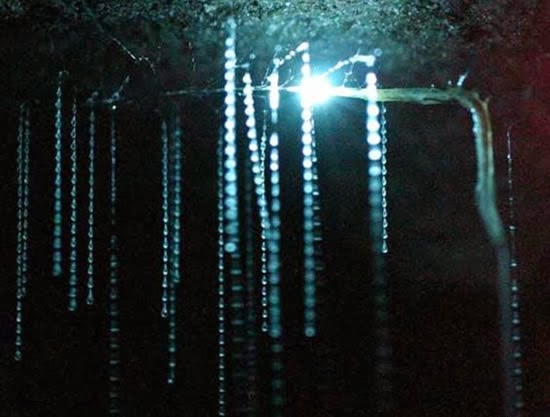
(Fig. 2) The glow-worms deadly web traps and the bioluminescent tail-
light of a glow-worm in a New Zealand cave

See that neat little light glowing there? Thought so. Ya, that’s the New Zealand Glow Worm, that crazy little guy sure is bright isn’t he? Bioluminescence, a process by which an organism exhibits light through production of a chemical in an organ, isn’t extremely uncommon in extremophiles. It makes sense when you think about it, most of these guys live in really dark environments, so it doesn’t hurt to have a lamp sometimes.
See those strings with what appear to be little beads of water accumulated on them? Those aren’t strings, per se. They’re actually traps! The glow worm is carnivorous. It traps other insects in the webs, like a spider’s actually, and then it sucks their internal organs out via chemicals that cause their prey to liquefy. Gnarly little fellas aren’t they? But it doesn’t stop there; there are more files on this extremophile.
See, the glow worm is a larval stage, and they’re kind of dumb. With their over-territorial nature and lack of distinction they will actually cannibalize each other if one roams into another’s territory. What’s even worse, when the fly hatches from the larval form, it will often follow the lights of its larval brothers, flying right into its own traps to be consumed. As I said, not very bright.
In its glowy worm stage of gestation the creature only has one goal. Eat and convert that food into proteins. Eventually, when it has consumed enough it will cocoon itself, much like a butterfly, that pupa eventually becomes the fly.

From the 31 unknown species they uncovered in Movile’s chemosynthesis based cave to the strange and bizarre blind fish the villagers of Villa Luz depend on every year there is peculiar life all around us. Next let’s see what they discovered when they ventured down into the depths of the Ocean.

The Vents

For the longest time scientists believed that the sun was the ultimate catalyst for life on Earth. After all, it powered the microbes and the plants via photosynthetic rays. This in turn allowed the plants to turn Carbon Dioxide into useful oxygen for us, in turn creating the very atmosphere we need to survive. The sun is pretty important, so it makes sense that we didn’t think life could exist without it.
This heliocentric view was nice, I mean, it wrapped everything up in a nice neat little ball for scientists everywhere, the problem? It was wrong. Yes, the sun is necessary for life on Earth to exist and without it we certainly wouldn’t be here but it’s not vital for all life. Life just needs energy, where it obtains that source of energy can be a testament to the true sustainability of life. What ALVIN discovered in the bottom of the Marianas Trench in the 70’s is still being heavily researched by scientists today, but what made this hardy ecosystem able to adapt to the extreme conditions found at the depths of the oceans?

(Fig. 3) Microbial Polyextremophile life around volcanic vents.
Marianas Trench


Piezophile, Thermophile, Extremophile, Polyextremophile, all these terms apply to this dense microbial mat covering hydrothermal vents at the bottom of the oceans. At the extreme depths of the trench the pressure is so high that if you were to try to swim down without a specially developed pressurized suit you would most assuredly be doomed to implode. Our bodies are not capable of producing the external pressure to survive at these depths, but these little guys pictured above, and many ichthyologic (fish) species can.
That’s what a Piezophile is. An organism capable of exerting the outward pressure necessary to not be crushed by forces pushing inward on it. But that’s not the only incredible feature of creatures able to live at these depths. The waters down there are usually very dark and cold, leading most predatory species to rely on other senses in order to feed. Also, as I stated earlier the microbes need some kind of energy to feed on as well. So what keeps those mats from drying up and dying out?
Tectonic plates and the core of planet to be exact. See, the bottom of the ocean is littered with what we call hydrothermal vents. These openings in the Earth basically spit out the superheated contents of the core, venting the pressure so our planet doesn’t explode. Naturally the contents have to very hot, but the pressure at these depths keep the water from reaching a vapor form (in other words, boiling point cannot be achieved) but the end result is a superheated area that can sustain the bacteria and other microbial organisms that have learned to adapt to it. The Piezo-Hydro-Chemolithautorophic-Thermophilic guys are so complex they are actually put into a category all their own.
The Polyextremophile, which is an organism exhibiting more than one quality of a standard extremophile. So you see now why these guys are still under such heavy study? Problems arise however when trying to remove these creatures from their native habitat. Changes in pressure, temperature, and chemical intakes cause specimens to rapidly decay leaving us to study them where they lay. But that’s not really such a bad thing, I mean, who doesn’t like a good swim?

Deep Waters

As we stated above the deep ocean is home to many strange species indeed, these areas that go miles below sea level where no light can reach are intensely cold and heavily pressurized. We used to think life couldn’t exist down there; here are some pictures so show just how wrong we were:

(Fig.4) Deep-sea Angler Fish

(Fig. 5) Deep-sea Angler Fish (Bioluminescent)

(Fig.6) The Mouthless Tube Worm

(Fig. 7) The Yeti Crab

So you see, in places like Lake Vostok we have discovered life (Cryophiles) and in the acidic waters of Yellowstone we have discovered entire ecosystems that we never thought could exist (Acidophiles). That is why it so important we explore every avenue for possible life. This is a growing field, every day we’re discovering more and more about these strange creatures that share our world.
That is what has made NASA so interested in all of this. If we can find life in these places, that survive off the methods they do when everything on our planet right now tells them they don’t even have to, imagine what we’ll find out in space where things have to evolve without the luxury of a lush atmosphere to fall back on evolutionarily. In the coming years the methods we use to cleanly extract and study these organisms will be vital to the coming mission on NASA’s and other space organizations rosters.
Are we going to find life as diverse on these other planets and moons as we do in the most unforgiving environments on our planet? I’m doubtful but I’d never rule it out. If life can evolve from a single-celled organism here then what’s to say it can’t there? The age of Anthropocentricism as at an end, now that we know what we should be looking for.
I don’t care who finds it, I just want it to be found. I firmly believe there is life out there in places like Io, Titan, and Europa. The key to finding it is locked away in these organisms right here that share this world with us. I’m just glad we’re finally opening the lock.

-Ryan Sanders

From “The Far Side” by the brilliant “Gary Larson”

Thank you all so much for reading this four part series I've put together. It took a lot of hard work and research to pull all of this together for you. I hope you've enjoyed it and come back in the future for more exploration into the wonderful world of science. Happy learning everyone!

-Sincerely,
              Ryan Sanders