Showing posts with label #Europa. Show all posts

Saturday, May 17, 2014

Mission to Europa: Life as We Thought We Knew It


We’ve talked about Europa and the search for extraterrestrial life on the ice giant here at To Infinity and…In Theory before. We’ve delved into life’s ability to thrive in some of the most hostile environments imaginable. (Missed those entries? Catch up on the four part series “Livin’ Life to the Extremophile” by following these links. Part 1: Vostok. Part 2: Europa. Part 3: Chemosynthesis. Part 4: Biodiversity.)
But when we talked about all that stuff before we didn’t talk very much about the most important thing. How exactly are we going to get underneath the huge sheet of ice surrounding Europa to the ocean of frozen mystery beneath? Scientists at several different agencies, from the big ones like NASA and the ESA to other firms like Stone Aerospace and Honeybee Robotics, are coming together to help answer that question.
The answer seems to lie in a multi-stage plan that will play out over the course of a few decades. Further testing still needs to be done to decide what will be the best approach for drilling into the ice for starters. Then the funding has to be raised in order to launch a mission of this scale. Luckily, researchers think they have an answer to that as well.
Today we’re going to talk about Jupiter and her moons, a program called JUICE, a payload delivery system called The Penetrator, cryobots, and a mission to Europa just to listen to the ice.
But first, a quick recap on why Europa is so promising in the search for life.

Sometimes You Just Have To Vent


For the longest time scientists purported that life could not exist at the depths of the ocean. The pressure was too high, it would crush anything organic. The light didn’t reach, nothing could possibly see to hunt and forage. Above all it would be far too cold. Then a mission to the outskirts of the Marianas Trench changed everyone’s tune. Not only was life discovered at the deepest depths at that time reached, but it was thriving.
Now we know that life is even capable of existing around some of the most hostile environments imaginable by using a process called Chemosynthesis. These hostile environments I’m talking about are the hydrothermal vents at the bottom of the ocean. Think of it like an underwater volcano.
As the ocean floor shifts due to tectonic activity from the way gravity affects our planet as it whirls through space, it causes buildups of pressure. This internal pressure has to be released somehow, so it vents it out to the ocean floor. Amongst this debris are little organic bits. Not stuff you and I like, but the kind of stuff microorganisms flourish on.
The same kind of thing is happening on Europa. It’s believed to have a rocky mantle and a molten iron core just like us. As it orbits around Jupiter, the stress from the gas giant’s gravitational force causes geothermal activity within the core. Just like our planet it has to be vented, hence the proposal for hydrothermal vents.
Only the surface is thought to be ice, the thickest ice in our solar system, but underneath that is believed to be a liquid ocean. If scientists are right the hydrothermal activity is what would make this possible, heating the water just enough to keep it from freezing near the mantle. How can they guess this from a few flybys and satellite snapshots?


The surface of Europa’s ice sheet is heavily scarred, and most of it isn’t from collisions with interstellar objects. Like Lake Vostok, a pocket lake within a sheet of ice in Antarctica, Europa is believed to be dotted with miniature bodies of water. The reason is because of the pattern of the scarring, there is no uniform structure to it.
It’s possible that as the moon orbits Jupiter the stress causes the ice to crack, but it wouldn’t be quite so varied and so jagged. When hydrothermal activity increases on the ice it may briefly unthaw some of the ice above the pocket lake (not entirely) and shift the ice around, causing the terrain patterns.
So now that we know what’s probably happening underneath the ice, what’s the plan for getting us to it? I’m going to ask you to try to keep your mind out of the gutter as we move on to our next section…

The Penetrator: Between the Ice Sheets


Europa had better prepare its Uranus for scientist Sanjay Vijendran’s payload delivery system because it looks like whatever method the mission chooses to drill into the planet “The Penetrator” is what’s going to be getting it there. It’s already been “drilled” through its paces, and is officially marked as ready for space travel. It’s fairly light given what it does, meaning an orbiting craft could launch several at a time, and it’s extremely durable.
So what is it and how does it work?


During testing the Penetrator was aimed at a 10 ton block of ice in order to simulate the effects of what it will be like to land (or crash really) on the surface of Europa. Weighing 44 pounds, it hit the block at 760 MPH showing a peak deceleration of 24-25,000g. For a point of reference, an ejecting fighter pilot experiences 14gs and typical soft-landing spacecraft experience 30-40gs.
What’s even more incredible is it was fully loaded with instruments and everything was just fine. All that happened was a little cosmetic damage, a few scratches in the paint. Being that it’s capable of burrowing up to 3m into the surface without the use of a drill, this could be the most useful tool in planetary exploration to date. It could deliver a vast array of scientific equipment for analysis of various factors. From seismometers to chemical labs.
The Penetrator is split into two different sections, the warm bay and the cold bay. The cold bay is for taking in samples and the warm bay houses instruments and keeps them from being damaged by the extreme temperatures on Europa (minus 200 degrees Celsius).
Its designer, Vijendran, has made note of its advantages over soft landers. Where they have to slow down, this can hit at full force, so all the space wasted from expensive instrumentation meant to decelerate a craft can be utilized by other items.
And just what might those other things be? Let’s take a look at some of the other toys possibly going along for the ride to Europa.

Lasers, Auto-Gophers, And Cryobots, Oh My!


So now that we know how they intend to get onto the surface and drop off the equipment, what exactly are they bringing? And not just that, what exactly is this equipment going to do and how does it work? That’s a very good question and I’m so glad you asked it. The answer however is sort of difficult because as of the time of this writing, even the scientists aren’t sure what to pack in their lunchbox yet.
First and foremost they’re going to need something to drill into the ice. Secondly they’re going to need something to obtain and analyze samples. Lastly the equipment needs to be extremely durable and able to withstand the tremendously frigid temperatures.
Two scientists named Victoria Siegel and Kris Zacny have two very separate approaches to this same problem.

The Cryobot


According to Siegel’s team at Stone Aerospace the ocean is where it’s at, “That’s where the big stuff is going to be happening,” she says. But in order to get down to that “big stuff” we have to be able to drill through 10 km of ice. (That’s a little over 6 miles.) There is nowhere on Earth with a sheet of ice 6 miles thick. The Antarctic Ice Sheet is the closest we have at 2.6, but we’re still talking about something over double that. And it’s an exponentially colder and harsher environment trillions of miles away.
Not to mention drilling creates problems. There’s a lot of moving parts, in order to go deeper extensions need to be added, and if something breaks it’s not like a maintenance crew can just catch an interstellar taxi to Europa to fix it. The VALKYRIE cryobots hope to solve all of those problems and give the team just what they’re shooting for.
They have been working on a device since 2011 that is capable of using meltwater (water sucked up through the jets and heated) to bore its way through the ice. Once it reaches the ocean it will launch a small submarine from its belly to get a bird’s eye view of the world beneath the ice and to collect water samples to scan for signs of life.
Listen to how ScienceNews.org describes the working of the cryobot.

“The cryobot, a tube about as long as a compact car, holds wires coiled within a sleek aluminum frame and five jets arranged in a domed head. By heating aluminum blocks within the head, the cryobot can melt ice, and then suck in the water and shoot out hot streams. To thaw the ultracold ice of Europa, the bot will need to carry some sort of onboard nuclear reactor. Siegel and colleagues are testing their device on Earth using laser light pumped down a fiber optics wire connected to the machine.”

As of now the cryobot has moved into Phase-II of its development and the underwater submersible, being developed by NASA are solid candidates for the mission to Europa. The only thing (like most ambitious missions) that could possibly hold them back is funding. Launching a piece of equipment like that is costly and time will tell if the government is willing to shell out the funds necessary to give Stone Aerospace the chance to prowl the depths of Jupiter’s moon, and the go-ahead to launch a nuclear device to the surface of a foreign and pristine world.

The Auto-Gopher


The Auto-Gopher is a wire-line rotary hammer drill. In other words, it smashes its way through the ground as it digs into it. Kris Zacny of the company Honeybee Robotics believes that this is the way to go. It’s cheaper to use a drill then a robot, not to mention this will require a significant amount less power to operate. So how does it all work?
“It’s like a fishing rod,” Zacny says, “and at the end of the fishing line, you have a drill.” I suppose that’s an apt description if you’re used to fishing with explosives. (Metaphorically speaking) The teeth that jut out on the end of the drill are made of tungsten carbide and to get it through the particularly rough spots in the ice they gave it the ability to “thump” its way through by adding in a percussive system.
It only draws about 350 watts of power all in all. That’s less than your microwave uses. The whole thing is attached to a wire and pulley system so that sections don’t need to be added or removed. And now they have funding for an even better drill. From the same ScienceNews.org article check out this excerpt.

“Now the team is working on a new and improved drill, the AMNH Deep Drill, named after its funding source, the American Museum of Natural History. This drill will shuttle rock or ice cuttings to a container inside the tube instead of creating cores that have to be pulled from the borehole. And researchers plan to pack electronics and equipment, such as a microscope and sensors, inside the tube.”

This method has several advantages. It means every foot that the device goes down will be analyzed for scientific record and the Kevlar coated wire is strong and avoids using bulky extensions that would be difficult to add and remove. They’re also doing research into carbon nano-tubes (so did we! “Nano-Tech:Big Problems, Small Answers”) in order to make the device even more lightweight, making the Auto-Gopher just as, if not more, appealing to potential backers.
In my personal opinion they should combine the underwater submersible with the drill and go for broke. But what do I know? I do know that this is all expensive, and while the president wants to give funding to space programs, there isn’t a whole lot of money to spare, (what with the bankers needing bailouts for gold Cadillac’s, Rolex’s, and private jet fuel.) So what’s the plan?

Budget “Clipper”


NASA’s got a plan for Europa exploration as well. It’s called Clipper. It’s a highly advanced, extremely durable satellite that will optimally perform 45 flybys of the ice moon at varying altitudes. It will take highly advanced pictures of the surface, scan the exact thickness of the ice (right now the thickness is just an educated guess), document radiation levels in the atmosphere and record exact temperatures on the entirety of Europa, there are a host of other possibilities this device brings to the table as well.
The problem is the $2.2 billion price tag. The Obama administration is willing to work with NASA, but only to the extent of $1 billion. Dr. Britney Schmidt who is spear-heading Clipper is thrilled the President has brought Space Exploration to the party finally but the budget is less than ideal.
Another scientist however, by the name of Christopher McKay thinks that that will be plenty enough. If the whole goal is to examine the surface of Europa and scan under the ice then he has just the plan for them. He intends to land a camera and a microphone on the surface to “listen” to the ice.
No that isn’t a joke. As the ice moves around scientists will be able to tell exactly what’s going on beneath the surface. How they are able to do this eludes me but if there’s a person who can translate it then I can get behind it. While I doubt Europa will be appearing on the next Santana album for a live duet with the guitar playing legend, this “ice noise” could bring us one step closer to missions like Spiegel’s, Schmidt’s, and Zacny’s.
This kind of exploration builds confidence and public interest, which is exactly what missions like Clipper and the Auto-Gopher are hinging on now. But while America is scrambling for the scraps, the ESA grabbed a V-8 and got juiced up for a little mission of their own.

Europe JUICE-in’ Up For Europa


While NASA is tuned into the Europa station, the European Space Agency is looking at the whole picture. All three Galilean moons are thought to contain liquid water somewhere beneath the surface. If we’re going to be in the neighborhood, why not see all the sights? The ESA is planning to send a probe called JUICE (JUpiter ICy moons Explorer) into orbit around Callisto, Europa, and Ganymede.
The goal is to study the composition of water beneath, survey the topographical features of the planets more thoroughly, investigate their potentiality to contain life as we think we know it, and many, many other awesome plans. There’s something even better, this is already in the works.
The time frame to deliver JUICE to the Jovian system is 2030 with a launch from Earth taking place as early as 2022. The prospect of this is exciting and they have plenty of time to make revisions and add other instrumentation. Russia is developing most of the components and say what you will about their foreign policy, they make some really good stuff.
With all the options open to us above and many others that could become potential candidates in the future we will certainly be seeing some kind of landing within the next twenty to forty years. Time will tell. Speaking of time, here at TI&IT we like to delve into the history of things as well as the science, after all, what are we without our past?
The question really isn’t who discovered these moons, we attribute that to astronomer Galileo, but what some may not know is while he is credited, someone may have discovered them first. Let’s take a look at the remarkable past of Jupiter’s biggest satellites.

Galileo and the Medicean Planets


The photo above that looks like the scribbling of a madman in a ward is actually the handwriting of the brilliant Galileo Galilei himself. He discovered the planets sometime around 1609-1610 while he was making improvements to his telescope. He originally named them the Medicean Stars in honor of the Medici family, but later it was discovered they were moons.
And it wasn’t much later either. In fact, it may have been earlier. A man named Simon Marius, a German astronomer, had made observations a few days prior of the same nature. In 1614 he published his paper  “Mundus Lovialis” detailing his discovery of Jupiter’s moons. You can imagine this led to some heated debates between him and Galileo.


In the end it is irrelevant who discovered it first, Marius ultimately won out the name-calling as the celestial bodies Io, Ganymede, Europa, and Callisto were the names he selected. And thankfully history was kind enough to remember him for that. Remnants of his work are scarce but he’s credited as “a clever observer” which is probably not the most sought after title in the scientific community.
But then again, what are all of us now?
Jupiter’s moons are named after Greek mythology. To be exact they are named after the lovers of Zeus. For the sake of the length of this article already we won’t go into too much about this now, but I’m sure in the future we will be talking about Europa once again.

Europa’s Cold Future


While we probably won’t find space penguins orbiting around the moons of Jupiter or Saturn we may find some sort of life. That is if we can get the funding to get off the ground and get there. From cryobots to satellites there are a number of possibilities for exploring these intriguing heavenly worlds.
But as usual, money will hold scientific progress back. While that is depressing I hope you enjoyed this article on the future of Europa. Please share this around on Facebook and Twitter, I would be eternally grateful. Thank you all for reading, and enjoy this comical pun.


-Ryan Sanders

If you want to know more about any of the topics discussed above feel free to follow any of the links below! As always, thanks for reading and Happy Learning!

-       Wiki on Europa Clipper


Saturday, December 7, 2013

Livin' Life to the Extremophile: Biodiversity (Part 4)

So, to quickly recap. In the last 3 days we have traveled several miles below to the Antarctic ice shelf to see what’s happening down there. We’ve visited the deep and mysterious cave systems of Romania and Mexico. We’ve even braved the icy cold depths of the Marianas Trench and stared through the looking glass at planets a billion miles away! What else is there to cover?
The wildlife of course.

You didn’t think I was just going to leave you hanging did you?! To wrap up our spotlight on Extremophiles and their unique habitats, it seems fitting that we spend some time talking about the locals. Here are some of the most bizarre creatures our planet has to offer, and what it means to the future of exploration.

(Fig. 1) The Olm, or Proteus. Note the lack of eyes and pigmentation
this is due to its habitat where there is almost no light

The Caves

What a strange looking creature right? That little guy picture above is called the Olm, or the Proteus, and like the American mudpuppy, it’s one of a kind. It is the only cave-dwelling Chordate that we are aware of at the time of this writing, and it’s not just his bizarre looks that set him apart from the rest.
Dubbed “Human Fish” in Slovenian by the local population this strange amphibian evolved in the caves below Slovenia for centuries. It’s noted in the 1860s by explorers but didn’t become a creature of study until most recently. It has three toes on its front feet and two on the back. Why? Reduction. See, when Mother Nature decides a creature no longer needs something to survive; it removes them in favor of something more necessary.
Like eyes for instance.
Because the Olm is primarily aquatic and lives in the perpetual blackness of underground cave systems the eyes have regressed over time, leaving the sockets covered in a layer of skin. Essentially the Proteus is blind but it still retains sensitivity to light. It has rudimentary lungs but these play second fiddle to the brightly colored red gills he sports like flowers on either side of his head. The reason these gills are so vibrant is because of the lack of pigmentation in the little guy’s skin. Because the oxygen rich blood is red in those areas, and the skin is practically transparent, you can see the bright coloration clearly.
But like a superhero this little guy sure can hear! Its other senses have strongly developed over time, making up for its lack of sight. The Olm can live for decades without food, sitting motionless on the floor of its watery home, but unlike other aquatic animals that exhibit this kind of behavior, the Olm can take off at blinding speeds at a moment’s notice whereas other creature’s out there that slow down their metabolic functions are more slow-moving.
So is this guy an Extremophile? I’d say so. While it doesn’t really live in battery acid water or null-oxygen environments, its ability to survive up to ten years on the lipids and sugars it manufactures in its liver I’d say put it there.

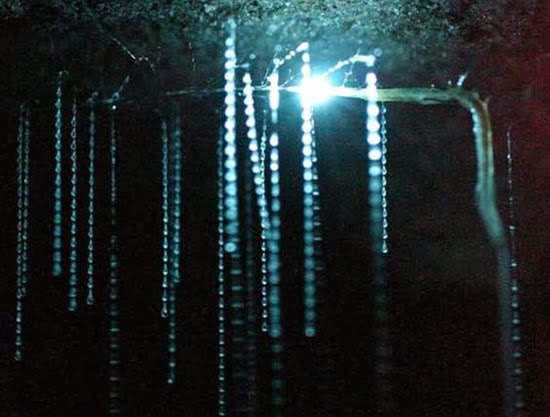
(Fig. 2) The glow-worms deadly web traps and the bioluminescent tail-
light of a glow-worm in a New Zealand cave

See that neat little light glowing there? Thought so. Ya, that’s the New Zealand Glow Worm, that crazy little guy sure is bright isn’t he? Bioluminescence, a process by which an organism exhibits light through production of a chemical in an organ, isn’t extremely uncommon in extremophiles. It makes sense when you think about it, most of these guys live in really dark environments, so it doesn’t hurt to have a lamp sometimes.
See those strings with what appear to be little beads of water accumulated on them? Those aren’t strings, per se. They’re actually traps! The glow worm is carnivorous. It traps other insects in the webs, like a spider’s actually, and then it sucks their internal organs out via chemicals that cause their prey to liquefy. Gnarly little fellas aren’t they? But it doesn’t stop there; there are more files on this extremophile.
See, the glow worm is a larval stage, and they’re kind of dumb. With their over-territorial nature and lack of distinction they will actually cannibalize each other if one roams into another’s territory. What’s even worse, when the fly hatches from the larval form, it will often follow the lights of its larval brothers, flying right into its own traps to be consumed. As I said, not very bright.
In its glowy worm stage of gestation the creature only has one goal. Eat and convert that food into proteins. Eventually, when it has consumed enough it will cocoon itself, much like a butterfly, that pupa eventually becomes the fly.

From the 31 unknown species they uncovered in Movile’s chemosynthesis based cave to the strange and bizarre blind fish the villagers of Villa Luz depend on every year there is peculiar life all around us. Next let’s see what they discovered when they ventured down into the depths of the Ocean.

The Vents

For the longest time scientists believed that the sun was the ultimate catalyst for life on Earth. After all, it powered the microbes and the plants via photosynthetic rays. This in turn allowed the plants to turn Carbon Dioxide into useful oxygen for us, in turn creating the very atmosphere we need to survive. The sun is pretty important, so it makes sense that we didn’t think life could exist without it.
This heliocentric view was nice, I mean, it wrapped everything up in a nice neat little ball for scientists everywhere, the problem? It was wrong. Yes, the sun is necessary for life on Earth to exist and without it we certainly wouldn’t be here but it’s not vital for all life. Life just needs energy, where it obtains that source of energy can be a testament to the true sustainability of life. What ALVIN discovered in the bottom of the Marianas Trench in the 70’s is still being heavily researched by scientists today, but what made this hardy ecosystem able to adapt to the extreme conditions found at the depths of the oceans?

(Fig. 3) Microbial Polyextremophile life around volcanic vents.
Marianas Trench


Piezophile, Thermophile, Extremophile, Polyextremophile, all these terms apply to this dense microbial mat covering hydrothermal vents at the bottom of the oceans. At the extreme depths of the trench the pressure is so high that if you were to try to swim down without a specially developed pressurized suit you would most assuredly be doomed to implode. Our bodies are not capable of producing the external pressure to survive at these depths, but these little guys pictured above, and many ichthyologic (fish) species can.
That’s what a Piezophile is. An organism capable of exerting the outward pressure necessary to not be crushed by forces pushing inward on it. But that’s not the only incredible feature of creatures able to live at these depths. The waters down there are usually very dark and cold, leading most predatory species to rely on other senses in order to feed. Also, as I stated earlier the microbes need some kind of energy to feed on as well. So what keeps those mats from drying up and dying out?
Tectonic plates and the core of planet to be exact. See, the bottom of the ocean is littered with what we call hydrothermal vents. These openings in the Earth basically spit out the superheated contents of the core, venting the pressure so our planet doesn’t explode. Naturally the contents have to very hot, but the pressure at these depths keep the water from reaching a vapor form (in other words, boiling point cannot be achieved) but the end result is a superheated area that can sustain the bacteria and other microbial organisms that have learned to adapt to it. The Piezo-Hydro-Chemolithautorophic-Thermophilic guys are so complex they are actually put into a category all their own.
The Polyextremophile, which is an organism exhibiting more than one quality of a standard extremophile. So you see now why these guys are still under such heavy study? Problems arise however when trying to remove these creatures from their native habitat. Changes in pressure, temperature, and chemical intakes cause specimens to rapidly decay leaving us to study them where they lay. But that’s not really such a bad thing, I mean, who doesn’t like a good swim?

Deep Waters

As we stated above the deep ocean is home to many strange species indeed, these areas that go miles below sea level where no light can reach are intensely cold and heavily pressurized. We used to think life couldn’t exist down there; here are some pictures so show just how wrong we were:

(Fig.4) Deep-sea Angler Fish

(Fig. 5) Deep-sea Angler Fish (Bioluminescent)

(Fig.6) The Mouthless Tube Worm

(Fig. 7) The Yeti Crab

So you see, in places like Lake Vostok we have discovered life (Cryophiles) and in the acidic waters of Yellowstone we have discovered entire ecosystems that we never thought could exist (Acidophiles). That is why it so important we explore every avenue for possible life. This is a growing field, every day we’re discovering more and more about these strange creatures that share our world.
That is what has made NASA so interested in all of this. If we can find life in these places, that survive off the methods they do when everything on our planet right now tells them they don’t even have to, imagine what we’ll find out in space where things have to evolve without the luxury of a lush atmosphere to fall back on evolutionarily. In the coming years the methods we use to cleanly extract and study these organisms will be vital to the coming mission on NASA’s and other space organizations rosters.
Are we going to find life as diverse on these other planets and moons as we do in the most unforgiving environments on our planet? I’m doubtful but I’d never rule it out. If life can evolve from a single-celled organism here then what’s to say it can’t there? The age of Anthropocentricism as at an end, now that we know what we should be looking for.
I don’t care who finds it, I just want it to be found. I firmly believe there is life out there in places like Io, Titan, and Europa. The key to finding it is locked away in these organisms right here that share this world with us. I’m just glad we’re finally opening the lock.

-Ryan Sanders

From “The Far Side” by the brilliant “Gary Larson”

Thank you all so much for reading this four part series I've put together. It took a lot of hard work and research to pull all of this together for you. I hope you've enjoyed it and come back in the future for more exploration into the wonderful world of science. Happy learning everyone!

-Sincerely,
              Ryan Sanders


Friday, December 6, 2013

Livin' Life to the Extremophile: Chemosynthesis (Part 3)


Greetings from Romania friend! Last time we talked about the distant planet Jupiter and her tantalizing moons that may or may not contain life. For now though, let’s put Europa, Io, Titan, and Enceledus on the back burner. Let’s talk about the creatures we recently discovered right here on Earth that live in places we originally never even thought to look for life.
In the first part we discussed Vostok Station and the skeptical past surrounding the historical outpost. Now we’re going to actually talk about the kind of creatures we can expect to find down there, and why avoiding surface contamination is absolutely essential in uncovering this fascinating alien world beneath our feet. We begin our journey in Romania with the discovery of an ancient cave by biologist Cristian Lascu.
From there we will be heading in the complete opposite direction. Instead of the bizarre albino insects of Molive cave we’ll be visiting the bizarre denizens of the deep around the vents of the Mariana Trench. Geothermal activity in this region plays a huge role in the evolution of sustainable life.
But it doesn’t just stop there. From pools of sulfuric acid in Yellowstone National Park, to strange non-pigmented air breathing detoxifying fish in Mexico, there is one thing that is incredibly evident in this peculiar little world of ours.
Life will always find a way.

Movile Cave – Romania


Movile Cave, Romania. A veritable hellscape to human beings. The air is thick with hydrogen sulfide and very little oxygen. In fact, the deeper you travel into its depths, the higher the likelihood you’ll need a respirator to keep breathing normally. That isn’t a problem for intrepid spelunker and biologist Cristian Lascu, who braved the harsh unforgiving environment to explore the world this cave system has kept hidden from us for hundreds of millions of years.
And what a find indeed! In what we would have ruled before as an uninhabitable climate he found life, and what’s more, the farther in he went, the more life he discovered, and the more diverse it would become. Centipedes, spiders, and other insects were present. What’s more is unlike other typical cave dwellers that tended to remain dormant and lethargic so as to conserve energy, these creatures were fast and highly active, as if there was no shortage of energy. But that was impossible, the cave was completely sealed off for a long, long time from outside intervention. What were these strange creatures using for energy in place of sunlight?
The answer lay in the water. Lascu dove into the underwater passageways and found that in a passageway that opened up to an air bubble there was a scum accumulated across the surface of the water. This scum, or biofilm as its more commonly referred to as, seemed to be the centerpiece for this self-contained ecosystem.
By a process called chemosynthesis these single-celled organisms were consuming the toxic chemicals in the water and converting them into energy. Their food chain made up the food chain for the insects food chain. Huh, funny how that whole circle of life thing works ain’t it? J. Chemosynthesis works a lot like photosynthesis does, except in place of sunlight as the catalyst a chemical component is used, in this case, hydrogen sulfate.

Marianas Trench – Pacific Ocean


That beautiful and expensive deep sea submarine is ALVIN and he’s more than just your average DSV. If it wasn’t for ALVIN the door to astrobiology wouldn’t have opened as quickly as it did. In 1977, scientists operating this little fellow around the Mariana Islands in between Japan and Australia found something that took their breath away.
Life.
Yes, the Mariana Trench, one of the coldest, highest pressured, darkest, and deepest places on our planet contains life. How incredible of a find indeed, and it wasn’t just of the microbial kind. Fish had adapted to the pressures, huge tube worms darted out at prey from the ocean floor, mussels lay scattered beneath ALVINs body. But what made this possible? Clearly these fish weren’t surviving by Chemosynthesis? That seemed highly unlikely.
Then it dawned on them. The geothermal vents along the ocean floor. The other incredible discovery that ALVIN had made. It had long been theorized that these openings from the Earth’s core existed, spewing super heated gases into the water as the tectonic plates shifted underneath. Microbes grew in mass along these vents, absorbing the super dense methane escaping the core. Methane, under normal circumstances is a gas, but as we learned on Titan, this isn’t always the case.
Even though the heat escaping these vents is enormously high, the water around them doesn’t boil. At these depths, the pressure is so high it raises the boiling point to unachievable levels. This phenomena is what keeps these microbes, the bottom of our seabed food chain, from burning up, and allows them the ability to reproduce and thrive in this hostile environment of the deep.

Yellowstone National Park – United States


            Astrobiology wasn’t the only new field brought about by these tiny single-celled marvels of life. In a whole other part of the world just ten years before, Dr. Thomas Brock was about to make a discovery that would turn the world of biology on its head. In The Great Fountain Region of Yellowstone National Park, was a whole new ecosystem just begging to be explored. One of the first to come out of this was Thermus aquaticus. A chemotroph (obtains its energy from chemical reactions rather than photosynthetic ones) that is also capable of sharing the photosynthesis of its cyanobacterial neighbors.
Not only had Dr. Brock just discover Hyperthermophiles, pioneered the future study of Extremophiles in general, but his discovery of T. aquaticus would later lead to breakthroughs in DNA fingerprinting analysis and the exciting new field of biotechnology!
But it wasn’t just this little Chemotroph that was new to the party. It turns out the bio mats found on the surfaces of such alkaline and sulfur rich water-sources was very similar to the mucous-like biofilm found on the water surface in Movile Cave. It was comprised of hundreds of microorganisms that had not only learned to adapt to their hostile environment, but actually had evolved to embrace it.
Cyanobacteria, Chemoorganotrophs, Green-sulfur bacteria, methanogens, gram-postive fermentative bacteria, these are some of the amazing new organisms they discovered that make up the complex ecological structure found here in Yellowstone. If life can take hold in a place like this, then perhaps life could thrive on Titan after all.

Cueva De Villa Luz – Mexico


The Villa Luz Cave. Found in Mexico this marvel has been featured on the BBC special “Planet Earth” in the past because it’s strange and diverse ecology. The air, much like Movile Cave’s, is rich is hydrogen sulfide, poisonous amounts actually. The difference is where Romania’s cave was sealed off, this one is open, by a main entrance and skylights throughout. However stalactites that hang from the ceiling are what help make the air unbearable, even with all the ventilation.
These unique stalactites, donned “snotties” by researchers give off a byproduct of the chemosynthesis. What is it you ask? Why sulfuric acid of course! This caustic substance hits the ground and as it melts through whatever it touches produces the noxious gases that fill the air, but this is just the start of the incredible and surprisingly well rounded ecosystem.
There is fish located here that has evolved within the dark depths. That’s not surprising since we discovered life living at the bottom of the Marianas Trench that we find a fish living in the dark. It also shouldn’t shock us that the “snotties” are constantly dropping acid bombs into the water effectively contaminating it with the stuff. But what should surprise us is how these fish are able to tolerate it.
Over time the Atlantic Mollies have developed a toxin screening system that allows them to breath and filter the water in the caves. This is a pretty remarkable development, but what’s even more incredible, they aren’t even the top of the food-chain in here! It turns out there’s an insect that preys on the mutated fish! Quite a turn of events if you ask me.
Another theory about their incredible immuno-system development comes from more recent scientists doing studies in the cave. The locals have long since incorporated the cave and the fish into their religious beliefs, using a poisonous mix of the Barbasco plant to kill them and bring them to the surface for easy harvest. Over time an immunity has begun to develop that these fish now seem to be passing on genetically to their offspring. Now that’s impressive.

Lake Vostok – Antarctica


I bet you  were wondering when I was going to get back to Lake Vostok. Well fret no more because here we are! Full circle! As of the time of this writing 3000+ species of organisms have been discovered living in the icy waters below. No new life has been found (contaminants only,sorry micro-geeks L) but the fact that life is down there at all is enough to make scientists everywhere go “hmm.”
It is truly incredible when you think about it. The water itself is assumed to be only 27 degrees F. This means that it’s below freezing. The only reason it stays in its liquid state they believe is because of geothermal heating underneath and the enormous pressures of the ice built up on top. The lake is essentially the creamy center of a geological Oreo.
Further analysis of the bacteria found in Lake Vostok will need to be undergone, but for now, it’s enough just to know that it’s down there. If bacteria can survive the inclimate conditions at the bottom of the ice shelf then it’s quite possible that it can survive the glacial temperatures likely to be found on Enceladus and Europa. Only time will tell.

In Conclusion

From “Nearing Zero” by the delightfully funny “Nick Kim”

         As I said earlier and as so hilariously somewhat discussed in the above comic, life will find a way to overcome and adapt every obstacle we or the world throws at it. The true test will be of whether or not we discover something new on Europa or on Titan. We’ve already seen some of the incredible ways they adapt, now let’s talk a second about how these things apply.
Europa is incredibly cold, but it has possible geothermic activity, the Marianas Trench is incredibly deep, dark, and cold. The pressures there would be unbearable for us but yet life has found a way to live harmoniously and in sync with the habitat. If we find similar features on Europa, it’s extremely possible that we find the signs of life that accompany those.
As for Titan, with its sulfurous and toxic surface it seems absurd for us to think of life being there, but then again they thought it was absurd for life to exist in places like Movile Cave and Ceuva De Villa Luz. We have methanogenic creatures right here on Earth and Titan is practically brimming over with liquid methane. It now seems even more improbably that life wouldn’t exist there considering.
Enceladus and Io may be dead ends, but we have found creatures thriving in the depths of volcanoes, and who knows. Perhaps there is a whole new kind of hyperthermophile out there that can survive even more severe conditions than the ones discussed in this article. Guess we won’t know till we get there, and I couldn’t be more excited to find out. J

-Ryan Sanders

For further reading on the places mentioned in this article and more on microbiology, you can follow any of the links below. Happy learning!

-       Dr.Thomas Brock’s “Life at Extreme Temperatures” (I rank this up there with Dr. Gold’s “The Deep Hot Biosphere” Both excellent studies with lots of overlapping information)
-       “A Natural View of Microbial Biodiversity within Hot Spring Cyanobacterial Mat Communities” A Scientific journal discussing in part life in Yellowstone.

In the fourth and final installment of our spotlight on Extremophiles we’re going to talk about the processes of some of the creatures (and the creatures themselves) that live in the hostile environments described above. Some are strange, some are cute, some are terrifying, but every single one of them, from single-cellular to conscious and complex, is a unique window into the tenacity of life.