Showing posts with label #microorganism. Show all posts

Sunday, December 8, 2013

Zombie Cells: The Undead Invade Nanotechnology


We’ve all been there. Sitting on the couch watching a scary movie on TV with a friend when the conversation begins. Zombies. What do we do in the event of an apocalypse? Do we gather canned food and bullets and fight it out with the hordes of the undead? Do we build a panic room and wait for their necrotic skin to decay reducing the human husks to emaciated mush in the streets? Or do we simply say, “yeah, that’s not possible, but it’s certainly damned entertaining.”?
Well, Zombie-like symptoms are possible, the thousand yard stare, the mindless shambling, the eternal hunger, (sounds like a teenager really…) modern pharmaceuticals carry those side effects. Necrotic flesh? Got it. It’s called Krokodil, people are actually drugging themselves with flesh eating diseases willingly now, (used to take a room full of Nazis and M-4s) not to mention the alleged cannibalistic urges employed from ingesting “Bath Salts” (NOT recommended or condonable behavior by the author of this blog) so is it here?
Nope. The reality is, the zombies you see in TV and films all share one thing in common. They are completely fictional. In order to have those zombies that you see in movies and TV  in real life there are several impossible factors that go into their creation. Let’s discuss the improbability first before we move into why we’re even talking about zombies in the first place.
First up, zombies are depicted as having insatiable hunger. The processes that cause the need to eat wouldn’t arise anymore in a zombie. If they are truly creatures of the undead then blood would not be pumping through their body anymore, it’d just be coagulated blobs congesting the veins and arteries (hence why you can shoot them in the heart and nothing happens). If there’s no blood pumping, the internal organs aren’t working, which mean signals that leptin and fat stores are low in the digestive tract don’t get sent to the brain. Without these signals, appetite, the main cause behind hunger, which is a sensation produced in the hypothalamus, the brain doesn’t know to tell the person to eat. Sorry guys, traditional zombies won’t be searching for flesh or brains.
It’s really important to note that according the monster movie lore, since zombies are technically dead and blood doesn’t move when you’re dead, that hunger is not the only thing affected by a lacking circulatory system. You need blood to keep your muscles fed. Without it they can’t move. (Rigor Mortis anybody?) If that blood has coagulated and just sits there, the shambling about that has affectionately coined the term “Walkers” on AMC’s “The Walking Dead” would actually be called “Grounders”. They may be able to moan and orally grunt and produce guttural sounds, but they certainly wouldn’t be moving toward you anytime soon. Eventually decay would overtake them and the groaning zombie would grunt until the brain stem fully atrophied. Point number two for the living.
Now what about the method of transfer? Common Zombiphile belief would lead us to say “Don’t get bit! Zombies make Zombies by biting and scratching!” This would simply not work. The main reasons viral and bacterial infections that transmit via bodily fluids are able to do so are by transferring themselves from host to host via bodily fluids. No blood is moving. Blood is no longer in a fluid state, plus the salivary glands that produce saliva would no longer be doing so, ergo a zombie bite wouldn’t be life threatening, just kinky in a disturbing way.
So why am I telling you all this? I’m sure some of you are bummed now and throwing away your zombie survival kits but don’t do that just yet (I mean…the government is still out there.) because researchers in New Mexico have just developed a new cell that the media has lovingly named the Zombie Cell, and researchers Townson and Brinker aren’t refuting this term. Let’s play mad scientist today here at “To Infinity and…In Theory” and see if we can’t stir up some cultures with these crazy Zombie Cells, straight out of a microbiological lab. I give you “Residency Evil” (See what I did there…some doctors’ titles are residents. :P)

Dawn of the Dead (…Cell)

It was a dark and stormy night. The fluorescent lights shone brightly off the stainless steel worktable in front of Dr. Jason Townson. He stroked his beard feverishly, trying to figure out what went wrong. He stared at the lifeless corpse in front of him on the table. Why isn’t it working! Then, out of nowhere, a bolt of lightning came crashing through the ceiling and struck the corpse, triumphantly, Dr. Townson raised his arms to the heavens yelling, “IT’S ALIVE!”
 …
Yeah…I didn’t think you’d buy that either.
While that makes for an entertaining made for TV movie that isn’t what researchers at Sandia labs were trying to accomplish. So what happened? What made these incredible zombie cells everyone’s been freaking out about??
The answer is actually quite astounding.
Silica.
That’s right; the same stuff that makes glass is now creating the undead cells we’re talking about. So how do they do it? Scientists took a living tissue sample from a pancreas. Through a complicated process they essentially washed the cell in silica acid. This opened the pores of the cell up nicely so the silica could get in there and do its work. What happened was it created a reinforced cellular structure, capable of withstanding extreme temperatures, retention of original function, and a seemingly endless half-life.
This Cell/Silica Composite (or CSC) on top of increased resistance to heat is also stronger when it comes to pressurization, not to mention it’s extremely malleable. For a long, long time scientists have been trying to create something silica based, that’s small enough to retain its 3D architectural structure over long expanses on a nano scale. (In other words they need something really strong, really small that is workable like rubber but resilient like titanium) Well, scientists now believe they have it.


That’s the Zombie Cell (Silica Biocomposite Cell) after being put through the two processes that give it its unique capabilities. The silica acid bath is nice. It makes the cell reinforced and strong and function perfectly. But what happens when we bake it? After going through a burn of about 400 degrees Celsius (around 900 Fahrenheit) all the proteins are burned out of it. This leaves a dead cell, with the original shape of the cell it was made from, but a cell that is capable of being re-programmed to perform some other function.
In fact, let’s talk about some of those functions now.

Biting Off More Than They Could Chew

In an interview with Huffington Post Live, the general consensus between the non-researchers was, “this is creepy.” That shows just how far the lack of understanding of biology has come. These cells can’t replicate (not to mention they aren’t being implicated into viruses or bacteria, just living cells) which means they can’t reproduce spreading an infection. So if the military isn’t trying to weaponize the undead, why are they creating these cells?
Jason Townson very plainly states, “We aren’t entirely sure of everything we can do with these yet.” The reality is creating 3D diatoms that retained their structures on such of a small scale had evaded researchers for years, to the point where many believed it couldn’t be done. When it began, they were just simply trying to prove it could happen, now that they have, they need to figure out what they can do with it.
The cells can withstand enormous amounts of pressure and heat so it’s obvious they could be used to create suits for harsh environments where no mortal soul can tread. Their miniscule size would make them perfect for building shielding around sensitive nano-electronics sent into space. Another use is in the medical field where a delivery mechanism for a cancer destroying agent in the form of a non-foreign cell is required. Scientists could take a cell from the afflicted individual, wash it in silica, install the anti-virus inoculation and send it on its way. So how is this possible?
Think of it like this. You’ve spent years working on a human-sized model of the Sears Tower made entirely out of Popsicle sticks. You’ve built the external frame, the rectangular shape of the skyscraper, but now it’s time to craft the more intricate details; it’s a model so it has to be accurate.
You spend days at the scroll saw, cutting small shapes of gargoyles, and curved window frames. Scaling down the small outcroppings that adorn the jutting edges of the building so they fit perfectly onto your tower. The problem? You weren’t completely accurate. Some of the molding is a little smaller than others and one of your gargoyles looks like it has downs syndrome. Sure would have been nice to have some pre-fabricated Popsicle sticks to finish your model off with.
Well thanks to Zombie Cells you can. With Zombie Cells you can take some Popsicle sticks that may be a different color than what you intended, inject them with the silica, add Popsicle stick/Sears Tower properties to it, and voila! You have a perfect gargoyle the same consistency as the rest of your model. Man that sure was easy.
This is obviously not the most accurate description of what is truly at work here but I hope it gives a little clearer understanding. What I’m essentially saying in that metaphor is that any living cell can be used in this process (as far as I’m aware of, this is fringe science so more research still has to be done) which leaves millions of shapes and sizes open to scientists to work with. By using different shapes they can create miniscule objects that are impossibly strong with properties not fully understood yet.
In other words…THIS IS SO COOL!


In closing I don’t believe this is the dawning of the end of the world. If anything that will probably come at the hands of the Hadron Collider (but we’ll save that story for another time). The cells they are using are not viral, can’t replicate, and as I effectively did above I may have ruined your outlook on the apocalypse. But cheer up guys, Neil deGrasse Tyson, a well renowned Astrophysicist has been quoted as saying “while Zombies are not real, I cannot, as a physicist, rule out the possibility that there is zombie-like life persisting under certain conditons and circumstances somewhere out there in the galaxy.”
In other words folks, Space Zombies.

-Ryan Sanders

For additional reading on zombie cells, you can follow any of the links below. As always, thanks for reading! Happy Learning!

-       Daily Mail UK article

Saturday, December 7, 2013

Livin' Life to the Extremophile: Biodiversity (Part 4)

So, to quickly recap. In the last 3 days we have traveled several miles below to the Antarctic ice shelf to see what’s happening down there. We’ve visited the deep and mysterious cave systems of Romania and Mexico. We’ve even braved the icy cold depths of the Marianas Trench and stared through the looking glass at planets a billion miles away! What else is there to cover?
The wildlife of course.

You didn’t think I was just going to leave you hanging did you?! To wrap up our spotlight on Extremophiles and their unique habitats, it seems fitting that we spend some time talking about the locals. Here are some of the most bizarre creatures our planet has to offer, and what it means to the future of exploration.

(Fig. 1) The Olm, or Proteus. Note the lack of eyes and pigmentation
this is due to its habitat where there is almost no light

The Caves

What a strange looking creature right? That little guy picture above is called the Olm, or the Proteus, and like the American mudpuppy, it’s one of a kind. It is the only cave-dwelling Chordate that we are aware of at the time of this writing, and it’s not just his bizarre looks that set him apart from the rest.
Dubbed “Human Fish” in Slovenian by the local population this strange amphibian evolved in the caves below Slovenia for centuries. It’s noted in the 1860s by explorers but didn’t become a creature of study until most recently. It has three toes on its front feet and two on the back. Why? Reduction. See, when Mother Nature decides a creature no longer needs something to survive; it removes them in favor of something more necessary.
Like eyes for instance.
Because the Olm is primarily aquatic and lives in the perpetual blackness of underground cave systems the eyes have regressed over time, leaving the sockets covered in a layer of skin. Essentially the Proteus is blind but it still retains sensitivity to light. It has rudimentary lungs but these play second fiddle to the brightly colored red gills he sports like flowers on either side of his head. The reason these gills are so vibrant is because of the lack of pigmentation in the little guy’s skin. Because the oxygen rich blood is red in those areas, and the skin is practically transparent, you can see the bright coloration clearly.
But like a superhero this little guy sure can hear! Its other senses have strongly developed over time, making up for its lack of sight. The Olm can live for decades without food, sitting motionless on the floor of its watery home, but unlike other aquatic animals that exhibit this kind of behavior, the Olm can take off at blinding speeds at a moment’s notice whereas other creature’s out there that slow down their metabolic functions are more slow-moving.
So is this guy an Extremophile? I’d say so. While it doesn’t really live in battery acid water or null-oxygen environments, its ability to survive up to ten years on the lipids and sugars it manufactures in its liver I’d say put it there.

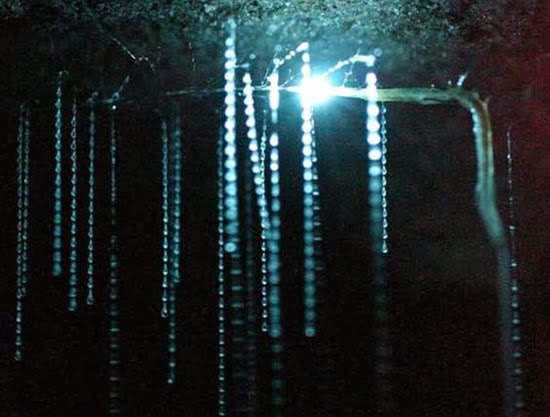
(Fig. 2) The glow-worms deadly web traps and the bioluminescent tail-
light of a glow-worm in a New Zealand cave

See that neat little light glowing there? Thought so. Ya, that’s the New Zealand Glow Worm, that crazy little guy sure is bright isn’t he? Bioluminescence, a process by which an organism exhibits light through production of a chemical in an organ, isn’t extremely uncommon in extremophiles. It makes sense when you think about it, most of these guys live in really dark environments, so it doesn’t hurt to have a lamp sometimes.
See those strings with what appear to be little beads of water accumulated on them? Those aren’t strings, per se. They’re actually traps! The glow worm is carnivorous. It traps other insects in the webs, like a spider’s actually, and then it sucks their internal organs out via chemicals that cause their prey to liquefy. Gnarly little fellas aren’t they? But it doesn’t stop there; there are more files on this extremophile.
See, the glow worm is a larval stage, and they’re kind of dumb. With their over-territorial nature and lack of distinction they will actually cannibalize each other if one roams into another’s territory. What’s even worse, when the fly hatches from the larval form, it will often follow the lights of its larval brothers, flying right into its own traps to be consumed. As I said, not very bright.
In its glowy worm stage of gestation the creature only has one goal. Eat and convert that food into proteins. Eventually, when it has consumed enough it will cocoon itself, much like a butterfly, that pupa eventually becomes the fly.

From the 31 unknown species they uncovered in Movile’s chemosynthesis based cave to the strange and bizarre blind fish the villagers of Villa Luz depend on every year there is peculiar life all around us. Next let’s see what they discovered when they ventured down into the depths of the Ocean.

The Vents

For the longest time scientists believed that the sun was the ultimate catalyst for life on Earth. After all, it powered the microbes and the plants via photosynthetic rays. This in turn allowed the plants to turn Carbon Dioxide into useful oxygen for us, in turn creating the very atmosphere we need to survive. The sun is pretty important, so it makes sense that we didn’t think life could exist without it.
This heliocentric view was nice, I mean, it wrapped everything up in a nice neat little ball for scientists everywhere, the problem? It was wrong. Yes, the sun is necessary for life on Earth to exist and without it we certainly wouldn’t be here but it’s not vital for all life. Life just needs energy, where it obtains that source of energy can be a testament to the true sustainability of life. What ALVIN discovered in the bottom of the Marianas Trench in the 70’s is still being heavily researched by scientists today, but what made this hardy ecosystem able to adapt to the extreme conditions found at the depths of the oceans?

(Fig. 3) Microbial Polyextremophile life around volcanic vents.
Marianas Trench


Piezophile, Thermophile, Extremophile, Polyextremophile, all these terms apply to this dense microbial mat covering hydrothermal vents at the bottom of the oceans. At the extreme depths of the trench the pressure is so high that if you were to try to swim down without a specially developed pressurized suit you would most assuredly be doomed to implode. Our bodies are not capable of producing the external pressure to survive at these depths, but these little guys pictured above, and many ichthyologic (fish) species can.
That’s what a Piezophile is. An organism capable of exerting the outward pressure necessary to not be crushed by forces pushing inward on it. But that’s not the only incredible feature of creatures able to live at these depths. The waters down there are usually very dark and cold, leading most predatory species to rely on other senses in order to feed. Also, as I stated earlier the microbes need some kind of energy to feed on as well. So what keeps those mats from drying up and dying out?
Tectonic plates and the core of planet to be exact. See, the bottom of the ocean is littered with what we call hydrothermal vents. These openings in the Earth basically spit out the superheated contents of the core, venting the pressure so our planet doesn’t explode. Naturally the contents have to very hot, but the pressure at these depths keep the water from reaching a vapor form (in other words, boiling point cannot be achieved) but the end result is a superheated area that can sustain the bacteria and other microbial organisms that have learned to adapt to it. The Piezo-Hydro-Chemolithautorophic-Thermophilic guys are so complex they are actually put into a category all their own.
The Polyextremophile, which is an organism exhibiting more than one quality of a standard extremophile. So you see now why these guys are still under such heavy study? Problems arise however when trying to remove these creatures from their native habitat. Changes in pressure, temperature, and chemical intakes cause specimens to rapidly decay leaving us to study them where they lay. But that’s not really such a bad thing, I mean, who doesn’t like a good swim?

Deep Waters

As we stated above the deep ocean is home to many strange species indeed, these areas that go miles below sea level where no light can reach are intensely cold and heavily pressurized. We used to think life couldn’t exist down there; here are some pictures so show just how wrong we were:

(Fig.4) Deep-sea Angler Fish

(Fig. 5) Deep-sea Angler Fish (Bioluminescent)

(Fig.6) The Mouthless Tube Worm

(Fig. 7) The Yeti Crab

So you see, in places like Lake Vostok we have discovered life (Cryophiles) and in the acidic waters of Yellowstone we have discovered entire ecosystems that we never thought could exist (Acidophiles). That is why it so important we explore every avenue for possible life. This is a growing field, every day we’re discovering more and more about these strange creatures that share our world.
That is what has made NASA so interested in all of this. If we can find life in these places, that survive off the methods they do when everything on our planet right now tells them they don’t even have to, imagine what we’ll find out in space where things have to evolve without the luxury of a lush atmosphere to fall back on evolutionarily. In the coming years the methods we use to cleanly extract and study these organisms will be vital to the coming mission on NASA’s and other space organizations rosters.
Are we going to find life as diverse on these other planets and moons as we do in the most unforgiving environments on our planet? I’m doubtful but I’d never rule it out. If life can evolve from a single-celled organism here then what’s to say it can’t there? The age of Anthropocentricism as at an end, now that we know what we should be looking for.
I don’t care who finds it, I just want it to be found. I firmly believe there is life out there in places like Io, Titan, and Europa. The key to finding it is locked away in these organisms right here that share this world with us. I’m just glad we’re finally opening the lock.

-Ryan Sanders

From “The Far Side” by the brilliant “Gary Larson”

Thank you all so much for reading this four part series I've put together. It took a lot of hard work and research to pull all of this together for you. I hope you've enjoyed it and come back in the future for more exploration into the wonderful world of science. Happy learning everyone!

-Sincerely,
              Ryan Sanders


Friday, December 6, 2013

Livin' Life to the Extremophile: Chemosynthesis (Part 3)


Greetings from Romania friend! Last time we talked about the distant planet Jupiter and her tantalizing moons that may or may not contain life. For now though, let’s put Europa, Io, Titan, and Enceledus on the back burner. Let’s talk about the creatures we recently discovered right here on Earth that live in places we originally never even thought to look for life.
In the first part we discussed Vostok Station and the skeptical past surrounding the historical outpost. Now we’re going to actually talk about the kind of creatures we can expect to find down there, and why avoiding surface contamination is absolutely essential in uncovering this fascinating alien world beneath our feet. We begin our journey in Romania with the discovery of an ancient cave by biologist Cristian Lascu.
From there we will be heading in the complete opposite direction. Instead of the bizarre albino insects of Molive cave we’ll be visiting the bizarre denizens of the deep around the vents of the Mariana Trench. Geothermal activity in this region plays a huge role in the evolution of sustainable life.
But it doesn’t just stop there. From pools of sulfuric acid in Yellowstone National Park, to strange non-pigmented air breathing detoxifying fish in Mexico, there is one thing that is incredibly evident in this peculiar little world of ours.
Life will always find a way.

Movile Cave – Romania


Movile Cave, Romania. A veritable hellscape to human beings. The air is thick with hydrogen sulfide and very little oxygen. In fact, the deeper you travel into its depths, the higher the likelihood you’ll need a respirator to keep breathing normally. That isn’t a problem for intrepid spelunker and biologist Cristian Lascu, who braved the harsh unforgiving environment to explore the world this cave system has kept hidden from us for hundreds of millions of years.
And what a find indeed! In what we would have ruled before as an uninhabitable climate he found life, and what’s more, the farther in he went, the more life he discovered, and the more diverse it would become. Centipedes, spiders, and other insects were present. What’s more is unlike other typical cave dwellers that tended to remain dormant and lethargic so as to conserve energy, these creatures were fast and highly active, as if there was no shortage of energy. But that was impossible, the cave was completely sealed off for a long, long time from outside intervention. What were these strange creatures using for energy in place of sunlight?
The answer lay in the water. Lascu dove into the underwater passageways and found that in a passageway that opened up to an air bubble there was a scum accumulated across the surface of the water. This scum, or biofilm as its more commonly referred to as, seemed to be the centerpiece for this self-contained ecosystem.
By a process called chemosynthesis these single-celled organisms were consuming the toxic chemicals in the water and converting them into energy. Their food chain made up the food chain for the insects food chain. Huh, funny how that whole circle of life thing works ain’t it? J. Chemosynthesis works a lot like photosynthesis does, except in place of sunlight as the catalyst a chemical component is used, in this case, hydrogen sulfate.

Marianas Trench – Pacific Ocean


That beautiful and expensive deep sea submarine is ALVIN and he’s more than just your average DSV. If it wasn’t for ALVIN the door to astrobiology wouldn’t have opened as quickly as it did. In 1977, scientists operating this little fellow around the Mariana Islands in between Japan and Australia found something that took their breath away.
Life.
Yes, the Mariana Trench, one of the coldest, highest pressured, darkest, and deepest places on our planet contains life. How incredible of a find indeed, and it wasn’t just of the microbial kind. Fish had adapted to the pressures, huge tube worms darted out at prey from the ocean floor, mussels lay scattered beneath ALVINs body. But what made this possible? Clearly these fish weren’t surviving by Chemosynthesis? That seemed highly unlikely.
Then it dawned on them. The geothermal vents along the ocean floor. The other incredible discovery that ALVIN had made. It had long been theorized that these openings from the Earth’s core existed, spewing super heated gases into the water as the tectonic plates shifted underneath. Microbes grew in mass along these vents, absorbing the super dense methane escaping the core. Methane, under normal circumstances is a gas, but as we learned on Titan, this isn’t always the case.
Even though the heat escaping these vents is enormously high, the water around them doesn’t boil. At these depths, the pressure is so high it raises the boiling point to unachievable levels. This phenomena is what keeps these microbes, the bottom of our seabed food chain, from burning up, and allows them the ability to reproduce and thrive in this hostile environment of the deep.

Yellowstone National Park – United States


            Astrobiology wasn’t the only new field brought about by these tiny single-celled marvels of life. In a whole other part of the world just ten years before, Dr. Thomas Brock was about to make a discovery that would turn the world of biology on its head. In The Great Fountain Region of Yellowstone National Park, was a whole new ecosystem just begging to be explored. One of the first to come out of this was Thermus aquaticus. A chemotroph (obtains its energy from chemical reactions rather than photosynthetic ones) that is also capable of sharing the photosynthesis of its cyanobacterial neighbors.
Not only had Dr. Brock just discover Hyperthermophiles, pioneered the future study of Extremophiles in general, but his discovery of T. aquaticus would later lead to breakthroughs in DNA fingerprinting analysis and the exciting new field of biotechnology!
But it wasn’t just this little Chemotroph that was new to the party. It turns out the bio mats found on the surfaces of such alkaline and sulfur rich water-sources was very similar to the mucous-like biofilm found on the water surface in Movile Cave. It was comprised of hundreds of microorganisms that had not only learned to adapt to their hostile environment, but actually had evolved to embrace it.
Cyanobacteria, Chemoorganotrophs, Green-sulfur bacteria, methanogens, gram-postive fermentative bacteria, these are some of the amazing new organisms they discovered that make up the complex ecological structure found here in Yellowstone. If life can take hold in a place like this, then perhaps life could thrive on Titan after all.

Cueva De Villa Luz – Mexico


The Villa Luz Cave. Found in Mexico this marvel has been featured on the BBC special “Planet Earth” in the past because it’s strange and diverse ecology. The air, much like Movile Cave’s, is rich is hydrogen sulfide, poisonous amounts actually. The difference is where Romania’s cave was sealed off, this one is open, by a main entrance and skylights throughout. However stalactites that hang from the ceiling are what help make the air unbearable, even with all the ventilation.
These unique stalactites, donned “snotties” by researchers give off a byproduct of the chemosynthesis. What is it you ask? Why sulfuric acid of course! This caustic substance hits the ground and as it melts through whatever it touches produces the noxious gases that fill the air, but this is just the start of the incredible and surprisingly well rounded ecosystem.
There is fish located here that has evolved within the dark depths. That’s not surprising since we discovered life living at the bottom of the Marianas Trench that we find a fish living in the dark. It also shouldn’t shock us that the “snotties” are constantly dropping acid bombs into the water effectively contaminating it with the stuff. But what should surprise us is how these fish are able to tolerate it.
Over time the Atlantic Mollies have developed a toxin screening system that allows them to breath and filter the water in the caves. This is a pretty remarkable development, but what’s even more incredible, they aren’t even the top of the food-chain in here! It turns out there’s an insect that preys on the mutated fish! Quite a turn of events if you ask me.
Another theory about their incredible immuno-system development comes from more recent scientists doing studies in the cave. The locals have long since incorporated the cave and the fish into their religious beliefs, using a poisonous mix of the Barbasco plant to kill them and bring them to the surface for easy harvest. Over time an immunity has begun to develop that these fish now seem to be passing on genetically to their offspring. Now that’s impressive.

Lake Vostok – Antarctica


I bet you  were wondering when I was going to get back to Lake Vostok. Well fret no more because here we are! Full circle! As of the time of this writing 3000+ species of organisms have been discovered living in the icy waters below. No new life has been found (contaminants only,sorry micro-geeks L) but the fact that life is down there at all is enough to make scientists everywhere go “hmm.”
It is truly incredible when you think about it. The water itself is assumed to be only 27 degrees F. This means that it’s below freezing. The only reason it stays in its liquid state they believe is because of geothermal heating underneath and the enormous pressures of the ice built up on top. The lake is essentially the creamy center of a geological Oreo.
Further analysis of the bacteria found in Lake Vostok will need to be undergone, but for now, it’s enough just to know that it’s down there. If bacteria can survive the inclimate conditions at the bottom of the ice shelf then it’s quite possible that it can survive the glacial temperatures likely to be found on Enceladus and Europa. Only time will tell.

In Conclusion

From “Nearing Zero” by the delightfully funny “Nick Kim”

         As I said earlier and as so hilariously somewhat discussed in the above comic, life will find a way to overcome and adapt every obstacle we or the world throws at it. The true test will be of whether or not we discover something new on Europa or on Titan. We’ve already seen some of the incredible ways they adapt, now let’s talk a second about how these things apply.
Europa is incredibly cold, but it has possible geothermic activity, the Marianas Trench is incredibly deep, dark, and cold. The pressures there would be unbearable for us but yet life has found a way to live harmoniously and in sync with the habitat. If we find similar features on Europa, it’s extremely possible that we find the signs of life that accompany those.
As for Titan, with its sulfurous and toxic surface it seems absurd for us to think of life being there, but then again they thought it was absurd for life to exist in places like Movile Cave and Ceuva De Villa Luz. We have methanogenic creatures right here on Earth and Titan is practically brimming over with liquid methane. It now seems even more improbably that life wouldn’t exist there considering.
Enceladus and Io may be dead ends, but we have found creatures thriving in the depths of volcanoes, and who knows. Perhaps there is a whole new kind of hyperthermophile out there that can survive even more severe conditions than the ones discussed in this article. Guess we won’t know till we get there, and I couldn’t be more excited to find out. J

-Ryan Sanders

For further reading on the places mentioned in this article and more on microbiology, you can follow any of the links below. Happy learning!

-       Dr.Thomas Brock’s “Life at Extreme Temperatures” (I rank this up there with Dr. Gold’s “The Deep Hot Biosphere” Both excellent studies with lots of overlapping information)
-       “A Natural View of Microbial Biodiversity within Hot Spring Cyanobacterial Mat Communities” A Scientific journal discussing in part life in Yellowstone.

In the fourth and final installment of our spotlight on Extremophiles we’re going to talk about the processes of some of the creatures (and the creatures themselves) that live in the hostile environments described above. Some are strange, some are cute, some are terrifying, but every single one of them, from single-cellular to conscious and complex, is a unique window into the tenacity of life.