Showing posts with label #Earth Science. Show all posts

Thursday, January 16, 2014

Green Energy (Part 2): Just Leaf the Fuel Cells to the Flora

Yesterday at To Infinity And…In Theory we talked about Fuel Cells and their background story starting with the first man to dream them up (William Grove) and concluding with the man who sent them into space (Francis Bacon). If you missed yesterday’s entry don’t fret, you can catch up here. [Green Energy (Part 1): Four Score AndTwenty Years Ago Fuel Cells Were Born! …(ish)] Today we’re going to see how these pioneers who laid the very important groundwork for Hydrogen Fuel Cell technology are pushing the energy crisis out of the way.
After NASA witnessed the hidden potential of these tiny molecular powered batteries firsthand they were ecstatic to say the least. They jumped onboard the Green Tech train and launched some 200 projects using Fuel Cell research as the backbone. Sometimes it only takes one huge influence to boost innovation to invention. Since the 1960’s, laboratories all over the world have delved into these powerful technological marvels of science.
We’re going to talk just a little bit more about their history today (not much, we covered the history pretty well I think yesterday) starting from the bulky models used on Apollo to the silicon sheets half a nanometer thick today. We’ll also talk about how they work, how they charge them up, and a new harvesting technique that could make Fuel Cells the most cost effective energy option on the market to date.
Think you know Green Technology in and out? Well then, let’s put that knowledge to the test shall we.


It’s Not Easy Being Green


When Grove conceptualized the Fuel Cell in the late 1800s I doubt he had space travel in mind. Heck, at that point they barely had a grasp on it. But Francis Bacon’s Hydrox Fuel Cell blew everyone away in the middle of the 20th century. Yet the technology didn’t catch on, Ford still had a monopoly on propulsion, no one was interested in a product that had not been tested. After all, who in their right mind would want to be a guinea pig?
But NASA saw the promise. (Oh NASA, how I love you. For real.) It launched 200 projects into Fuel Cell technology and sure enough in the late 60s, Bacon’s Fuel Cells, with some slight modifications, made their journey into space a reality. They were also used again in a little project you might have heard of. Apollo, perhaps? Ring any bells? I really hope so because the Apollo program accomplished one of the greatest feats of all time.
Apollo 11 put a man on the moon.
Yep, Apollo 11 was far more important than just the prequel to Apollo 13, (no Tom Hanks here, sorry folks!) it was the mission where Neil Armstrong planted the American flag on the lunar surface. (We really have to stop claiming things that technically don’t belong to us…) But how did this happen? Well there were millions of parts in motion, but an important aspect of the mission was a Fuel Cell.
More importantly, not only was the Fuel Cell capable of splitting Hydrogen and Oxygen in order to produce energy, it could reassemble the molecules to turn them back into water. I’m sure it was filtered, but this is what the Astronauts drank. Hydro Fuel Cell H2O.
So how does it do this? It’s pretty cool actually; I’ll break it down for you.
The Bacon Cell is essentially an Alkaline Fuel Cell, and boy are they efficient. What’s happening is called a Redox reaction. (Red = Reduction, Ox = Oxidation). This can be as simple as oxidation of carbon to yield Carbon Dioxide, or as complex as producing glucose inside the human body, both are forms of a Redox reaction.
Well this concept is happening inside the battery. (A stack of fuel cells). At the anode hydrogen is being oxidized. When this happens it enters its liquid state, water. It then re-enters the module and returns to the cathode where the water is then turned back to hydroxide ions. The cycle keeps repeating itself, thus creating a regenerative supply of energy. The best part of all you ask?
Electricity and heat are the byproducts. That means powering the ship, according to a molecule, is just their waste.
The electrodes are separated by an aqueous alkaline solution. It’s the catalyst for the reaction to produce water and electricity. There’s only one slight problem. If Carbon Dioxide gets into the Fuel Cell it can “poison” the entire system, compromising everyone onboard the ship. (Seen the new Sandra Bullock flick? Being compromised in space is scary stuff!) Because of this both pure oxygen is used and a scrubber is incorporated into the system so as to filter it after each pass. So why don’t we use this for the general public?
The poisoning effect we just talked about is one of the reasons. It can happen fairly easy, and if it does, it’s pretty much irreversible. Considering we expel carbon dioxide as waste from our lungs, we could potentially destroy the vehicle ourselves by just driving it. Ford would love it, but we’d be in the poor house. Pretty much, technology just wasn’t there yet for small, affordable, consumer models, after all, it was only the late 60’s, we didn’t even have Internet yet! (Or Google. What did we do before Google? I think it was like a library or like, something about Dewey…oh well.)
However that reality may not be so far away. In 1999 a transport boat that ran on AFC’s was put into commission. It was called the HYDRA. (Run Captain America!) Before they took it out of the water and decommissioned him he transported some 2,000 passengers and even won a few energy related competitions.
But now Fuel Cells, once again, have come out of the world of obscurity and are back in the spotlight. Yet now they aren’t just being looked at as a replacement technology because we might run out of gas. Now we need them because soon, we might kill the Earth if we keep it up, and running out of a planet is far more treacherous of a prospect then no more driving. At least to me, I don’t know how you feel about it.
So what are we doing to stop this bleak future from occurring? Researchers in Tennessee came up with a clever answer to that question. Let’s see what Popeye has to say about Science.

Eat Your Spinach, Sailor…


If you’re old enough to remember the man pictured above, then your childhood was most likely AWESOME! If not, I’m sorry…anyway. Do you know how Spinach makes the food it consumes? A little process called photosynthesis. Did you also know this produces chemical energy? Huh? Did ya!?
Well this chemical energy can be converted into another kind of energy, something of a kinetic variety. Mechanical energy to be exact, and at Oak Ridge National Laboratory in Tennessee, that’s exactly what scientists are looking to exploit.


It takes light 8 minutes to reach the leaves of the Spinach. In five trillionths of a second the plant is already converting that sunlight into energy. Where Alkaline Fuel Cells were efficient and their obvious replacement Silicon Fuel Cells was more so, the environment’s natural processes have billions of years ahead of us. While we’ve been trying to manufacture artificial versions of Mother Nature, Mother Nature has already created the perfect practice.
So how are they achieving this goal? Turns out you can infuse the leaves of spinach with platinum. Because chloroplast is already a conductor for the plant to make energy with, this platinum just enhances its natural abilities and suits it toward technology we can use. The best part of it all, it’s 100% green.
The platinum turns the spinach leaf into an electrical switch. Biometric scientists are looking toward this technology for use in the blind. It has the potential to be very effective for biotic eyes. Speed-of-light computers are also a potential for the same reason. The human retina registers light faster than anything we can currently build, but by using these platinum chloroplasts, it could provide the building block to make something that not only matches the speed at which the eye operates, but surpasses it as well.
Time will tell but I’m looking forward to this technology in the future. Want to know more about Spinach powered super computers? You can by clicking here.
So by now you’re probably asking yourself, “yeah that’s cool and all, but I thought this was about Fuel Cells.” Well…not that part in particular. But I just wanted you to understand the potential for plant based biotechnology, before I blew your mind. While they had one bionic eye on supercomputers when they were working with University of South Carolina to extract Spinach proteins, they had their other one trained on the future of sustainable energy.

Standing Fern on Green Energy


That complex tangle of green, yellow, and blue is actually fairly important to all of this. It’s called the Light Harvesting Complex, or LHC-II for short. It’s the protein that they pulled from the spinach responsible for the function of photosynthesis. The guys over at Clean Technica break it down the best:

Oak Ridge writer Bill Cabage describes the latest breakthrough as a biohybrid photoconversion system. The researchers were able to confirm that a particular light-harvesting protein derived from plain old supermarket spinach can be induced to assemble itself into a membrane, by putting it into a liquid solution containing synthetic polymers. The protein, called LHC-II (LHC stands for Light Harvesting Complex) interacts with the polymers to form a membrane, which in turn produces hydrogen. In other words the membrane acts as a kind of photovoltaic cell, but instead of generating electricity it generates-hydrogen.
Read more at 
Clean Technica

In short, clean, renewable, affordable, sustainable, and literally green as you can get energy. There is a catch though. This technology doesn’t come cheap. Platinum is incredibly expensive. But researchers at MIT may have an idea that could reduce that cost significantly.


“Leafing” It All Behind…


As I mentioned before, Platinum is super expensive stuff. Not to mention, it’s fairly uncommon as far as rare Earth elements go. Another problem with Fuel Cells was the ability to keep them self-contained and contaminate free. But that could theoretically be a thing of the past thanks the brilliant mind of Daniel Nocera. Toiling hard night and day in the bowels of MIT, he finally seemed to figure it all out.
He would grow trees that produced hydrogen instead of oxygen.
HA! Nope, but I had you going for a second there didn’t I? It might as well be that though considering the principle they operate on is exactly the same as a leaf.


No not the leaf, the thing on the leaf. And no, you don’t have to attach them to a leaf, they are self-contained and operational. No planting required. But the million dollar question is how do they work? It’s not a mystery, it’s just science.
When sunlight hits a leaf it begins to cause a chain reaction. The sunlight begins to convert chemicals within the leaf into free oxygen by breaking down water. That oxygen is then released back into the environment for us to breathe. This is basically how photosynthesis works though there are much more complex things happening, (HowStuffWorks.com will tell you all about it here.) But we should quickly clarify what we mean by “leaf”.
The artificial leaf may be a bit misleading; it’s actually called a Photoelectrocell. Photoelectrocells differ from Photovoltaic cells significantly. Voltaic cells generate voltage when light hits them, while Photoelectric cells generate electricity from light. Voltage determines the electric potential, meaning how much power there is going to be. (i.e 9V batter, 12V battery etc.) A Photoelectric cell converts it into electricity, like a solar panel, and its power is determinative of its capacity and how much energy is available. But anyhow, back to fake leaves.
By using the same basic principles of photosynthesis with only a few slight adjustments, Nocera created the little wafer pictured above to basically do just that. Except instead of producing free oxygen for us to breathe, it breaks down water into oxygen and hydrogen for us to use to power our cell phones, cars, laptops, and robotics. By placing it in a tankard of water (refilled daily) the Photoelectrocell can make all sorts of things happen.
And it’s fairly cheap.
Instead of running mostly on Platinum it uses very little of the precious element. It’s mainly comprised of Cobalt, Zinc, and other fairly inexpensive metals and minerals. The wafer is then coated in a sheet of silicon that is thick enough to better protect the metals from oxidation (rusting is a form of oxidation. Oxidation is what destroys the electrodes.) Yet thin enough to allow the reaction to take place effectively.
But in order for everything to work proper, clean water is the essential ingredient. Testing is currently underway to make one that can survive in slightly more contaminated environments but after a while it still clogs the chip and the process stops working. They also discovered another unique property of this, to a degree the silicon area of the chip will repair itself. Nocera and his team noticed this when they roughed up the surface in an attempt to discourage grime and biofilm from building up on the artificial leaf.
Unfortunately keeping contaminants out continues to be a problem. While a closed cell is possible, water is still needed for the initial catalyst. Clean water at that to avoid degrading the material faster than necessary. Not all parts of the world that could certainly benefit from this technology have ready access to clean water. Plus, in order to keep it cost effective, an open cell where water can continually be refilled is preferable as it wouldn’t have many special requirements that quickly add up to total wallet devastation over time. 

A Green Future (Literally)

As the price of solar technology continues to drop and the mass production of artificial leaves becomes a priority, Dr. Nocera claims we may see this technology in every household worldwide in as little as five years. But if there is one thing I know about the world it’s that the people with money don’t like to let go of it, and major power companies are not going to like this tech one bit.
Because of its potential to be extremely cheap to produce, it would be reasonably priced for the Consumer. If two panels cost $60, and two full size panels (we’re speculating here only) could potentially run a two story house, then pretty much anyone in the world could afford them, even in the most impoverished areas. Let’s face it; it would put Consumer’s Energy out of business and all other power countries worldwide.
Right now it’s estimated that the current cells cost around $6.50 USD to produce. While fossil fuels are sitting pretty at the height of popularity still, Fuel Cells are back. And just like when Grove powered the telegraph and truly became the definition of Avante Garde, they’re in line to change the way we live in this ever developing world.

-       Ryan Sanders


Thanks for reading! And as always if you want to know more about solar powered spinach, wireless Fuel Cells, or the artificial leaf and its creator follow any of the links below. Share it around, after all, everyone loves science!  Happy learning!


*Correction: In yesterday’s article I said the technology to turn Spinach into electrical switches was patented in the 1990’s. That was a typo. I meant 1980’s; the actual patent was issued in 1985. Sorry about that folks but mistakes do happen. - Ryan Sanders


Wednesday, January 8, 2014

The Color of Sand...Not as Bland as You Think


Ever been to the beach and got sand in your eye and said, “Darn that smarts!”? Well take a look at the picture above. That’s why. Lots of sharp, jagged, geometric characteristics comprise the miniscule grains of sand we find lying around us every day. Seems kind of incredible since every time we look at it all we see is an amalgamation of khaki color. How could each grain of sand be so unique in shape, size, and be so colorful? On our first day back from my little winter break here at To Infinity…And In Theory we’re going to explore sand. From its formation to its composition, and even a little bit about why it’s so much more important than just that annoying beach dirt that gets stuck in your swim trunks.

Just Sand? Ha! Don’t Be Silica…


So what exactly is sand made of? Well that mostly depends on where your sand came from. Sand is actually tiny fragments of broken down igneous rock that is carried by wind, water, or even glaciers that usually ends up as sediment in bodies of water or as dunes and deserts on land. But typically speaking sand is mostly comprised of silica. You may more commonly know this as it’s mineralized form, quartz.
Coral, Gypsum, Hematite, lava rock, all of these are different particles that can form a grain of sand. When analyzed, this can give geologists insight as to where the sand came from, for instance, if the sample is high in coral content and many of its neighbor particles are rounded marble shapes, it’s safe to assume it was formed in an ocean where the rolling waters wore down the rough edges and smoothed it to a spherical shape.
“Every grain of sand is a jewel waiting to be discovered.” This was so eloquently phrased by doctor (and photographer) Gary Greenberg after he had turned his microscopes to sand. The microscopic seashells and fragments he found within the ocean sediment were absolutely stunning. You can see more of his wonderful photography here.

Get a Room You Dirty Dune


Ever seen a sand dune make love?
Want to?
If that’s the case, not only are you a rather strange individual but you’re also probably pretty patient too, because in order to watch a sand dune mate with another dune you’ll be standing in your respective desert for possibly a year, dependent on the size of your dune. As wind blows against some kind of a backstop and picks up small grains of sand it will blow them into a dune formation. If the conditions are just right the wind can also push that dune across the desert.
But what happens if a smaller dune runs into a bigger dune? Does it just get swallowed up and disappear? Nope. That sandy hill turns into Kitty Pryde from the X-Men and phases right through it! Sometimes the edges of the crescent shape break off the bigger dune forming two smaller dunes. This is the process scientists refer to as breeding and takes a rather long time to accomplish.
And here you thought sloths were slow…

The Sandy (And Itchy) Lap of Luxury


The picture above is the innards of a watch. If you look at number seven on the list it says “Quartz Crystal.” Quartz is made of silica, in fact, its silica in its mineral form. It may not be a precious jewel but scientists have discovered that it is indeed quite useful. Why? In short, much like metal, quartz can conduct electricity, but not just like metal; it prefers to do things a little differently.
The process by which Quartz operates a current is called Piezoelectricity. This is the ability to convert voltage when placed under mechanical stress. It’s not just Quartz; certain ceramics have this property as well. How it works is Quartz maintains a specific frequency standard. Because of this scientists know exactly how it will react under certain situations and be able to use it in a variety of electronics, from computers to TV’s and even your Xbox Ones and PS4s. Furthermore, most quartz nowadays found in our technology is synthetic, allowing scientists to further tweak and groom it to whatever frequency they need it to be.
Another use for Silica is something you may or not be aware of. Take a look out your window. I mean a good, hard, long look. What do you see? A yard? Your kids playing with the dog? Maybe the neighbor digging his truck out from under six tons of snow? There are a million things any given one of you could see at this moment outside your window. But chances are you all have one thing in common. The glass you’re looking through.
Windows are thought to be a modern invention but if this were Jeopardy you’d have just answered that question wrong. Glass windows were discovered in the ruins of Pompeii leading archaeologists to the conclusion that glass was a luxury item, afforded by the rich and divine. If you had glass windows, you were part of the Elite. (Granted back in those days if you had anything above a dirt floor and a thatched roof you could be considered Mr. Fancy Pants.) But where did it come from?
There was a Roman Naturalist named Pliny the Elder who had an answer. The ancient Phoenicians. Ever heard of them? Probably not, they aren’t exactly widely talked about in high school curriculum. They should be however, as they are credited with many important discoveries that we use today, including pottery, trade, and jewelry.
Mostly contributing to the fields of seafaring and navigation, the Phoenicians were quite a clever bunch. They had to be, they spent the entirety of their lives going from unknown to unknown. On one of these trips, allegedly with Pliny along for the ride, they made camp on a beach along the coastlines of modern day Palestine. They quickly encountered a problem. There were no rocks nearby to support their pots as they cooked their dinner.
As I said though, they were a clever bunch and they returned to the ship and gathered up blocks of Saltpeter to use to prop their cookware up. As they ate, drank, and burned their fires through the night something strange was happening beneath the flames. The saltpeter and the quartz were melting into an unknown fluid. As the fires died and morning came the fluid had hardened into a solid. This colorful substance became known as glass.
In closing, sand is much more than just a beach-goers crotch nuisance. It provides us with plates to eat from, windows to keep the cold out, watches to make sure we get to work on time, and radios to blast Pantera at ungodly hours. It can be used to filter our water, provide traction on icy roads, and give us the extra grit to finish the body of that walnut and maple guitar we’ve been building. Sand is much more useful than you probably came into this article knowing.
Sand is much more than just a pretty grain.

-       Ryan Sanders


For further reading on any of the topics above feel free to visit any of the below listed websites, and as always thank you so much for reading! Happy learning everyone!


Saturday, December 7, 2013

Livin' Life to the Extremophile: Biodiversity (Part 4)

So, to quickly recap. In the last 3 days we have traveled several miles below to the Antarctic ice shelf to see what’s happening down there. We’ve visited the deep and mysterious cave systems of Romania and Mexico. We’ve even braved the icy cold depths of the Marianas Trench and stared through the looking glass at planets a billion miles away! What else is there to cover?
The wildlife of course.

You didn’t think I was just going to leave you hanging did you?! To wrap up our spotlight on Extremophiles and their unique habitats, it seems fitting that we spend some time talking about the locals. Here are some of the most bizarre creatures our planet has to offer, and what it means to the future of exploration.

(Fig. 1) The Olm, or Proteus. Note the lack of eyes and pigmentation
this is due to its habitat where there is almost no light

The Caves

What a strange looking creature right? That little guy picture above is called the Olm, or the Proteus, and like the American mudpuppy, it’s one of a kind. It is the only cave-dwelling Chordate that we are aware of at the time of this writing, and it’s not just his bizarre looks that set him apart from the rest.
Dubbed “Human Fish” in Slovenian by the local population this strange amphibian evolved in the caves below Slovenia for centuries. It’s noted in the 1860s by explorers but didn’t become a creature of study until most recently. It has three toes on its front feet and two on the back. Why? Reduction. See, when Mother Nature decides a creature no longer needs something to survive; it removes them in favor of something more necessary.
Like eyes for instance.
Because the Olm is primarily aquatic and lives in the perpetual blackness of underground cave systems the eyes have regressed over time, leaving the sockets covered in a layer of skin. Essentially the Proteus is blind but it still retains sensitivity to light. It has rudimentary lungs but these play second fiddle to the brightly colored red gills he sports like flowers on either side of his head. The reason these gills are so vibrant is because of the lack of pigmentation in the little guy’s skin. Because the oxygen rich blood is red in those areas, and the skin is practically transparent, you can see the bright coloration clearly.
But like a superhero this little guy sure can hear! Its other senses have strongly developed over time, making up for its lack of sight. The Olm can live for decades without food, sitting motionless on the floor of its watery home, but unlike other aquatic animals that exhibit this kind of behavior, the Olm can take off at blinding speeds at a moment’s notice whereas other creature’s out there that slow down their metabolic functions are more slow-moving.
So is this guy an Extremophile? I’d say so. While it doesn’t really live in battery acid water or null-oxygen environments, its ability to survive up to ten years on the lipids and sugars it manufactures in its liver I’d say put it there.

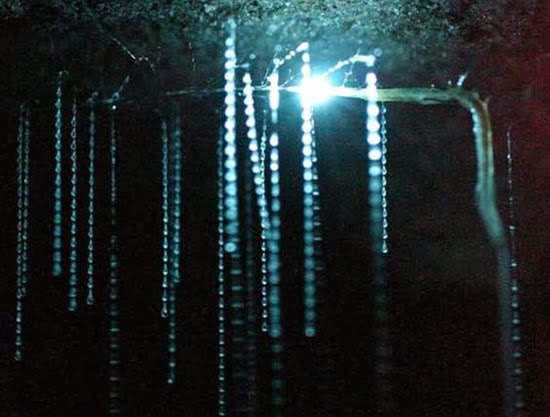
(Fig. 2) The glow-worms deadly web traps and the bioluminescent tail-
light of a glow-worm in a New Zealand cave

See that neat little light glowing there? Thought so. Ya, that’s the New Zealand Glow Worm, that crazy little guy sure is bright isn’t he? Bioluminescence, a process by which an organism exhibits light through production of a chemical in an organ, isn’t extremely uncommon in extremophiles. It makes sense when you think about it, most of these guys live in really dark environments, so it doesn’t hurt to have a lamp sometimes.
See those strings with what appear to be little beads of water accumulated on them? Those aren’t strings, per se. They’re actually traps! The glow worm is carnivorous. It traps other insects in the webs, like a spider’s actually, and then it sucks their internal organs out via chemicals that cause their prey to liquefy. Gnarly little fellas aren’t they? But it doesn’t stop there; there are more files on this extremophile.
See, the glow worm is a larval stage, and they’re kind of dumb. With their over-territorial nature and lack of distinction they will actually cannibalize each other if one roams into another’s territory. What’s even worse, when the fly hatches from the larval form, it will often follow the lights of its larval brothers, flying right into its own traps to be consumed. As I said, not very bright.
In its glowy worm stage of gestation the creature only has one goal. Eat and convert that food into proteins. Eventually, when it has consumed enough it will cocoon itself, much like a butterfly, that pupa eventually becomes the fly.

From the 31 unknown species they uncovered in Movile’s chemosynthesis based cave to the strange and bizarre blind fish the villagers of Villa Luz depend on every year there is peculiar life all around us. Next let’s see what they discovered when they ventured down into the depths of the Ocean.

The Vents

For the longest time scientists believed that the sun was the ultimate catalyst for life on Earth. After all, it powered the microbes and the plants via photosynthetic rays. This in turn allowed the plants to turn Carbon Dioxide into useful oxygen for us, in turn creating the very atmosphere we need to survive. The sun is pretty important, so it makes sense that we didn’t think life could exist without it.
This heliocentric view was nice, I mean, it wrapped everything up in a nice neat little ball for scientists everywhere, the problem? It was wrong. Yes, the sun is necessary for life on Earth to exist and without it we certainly wouldn’t be here but it’s not vital for all life. Life just needs energy, where it obtains that source of energy can be a testament to the true sustainability of life. What ALVIN discovered in the bottom of the Marianas Trench in the 70’s is still being heavily researched by scientists today, but what made this hardy ecosystem able to adapt to the extreme conditions found at the depths of the oceans?

(Fig. 3) Microbial Polyextremophile life around volcanic vents.
Marianas Trench


Piezophile, Thermophile, Extremophile, Polyextremophile, all these terms apply to this dense microbial mat covering hydrothermal vents at the bottom of the oceans. At the extreme depths of the trench the pressure is so high that if you were to try to swim down without a specially developed pressurized suit you would most assuredly be doomed to implode. Our bodies are not capable of producing the external pressure to survive at these depths, but these little guys pictured above, and many ichthyologic (fish) species can.
That’s what a Piezophile is. An organism capable of exerting the outward pressure necessary to not be crushed by forces pushing inward on it. But that’s not the only incredible feature of creatures able to live at these depths. The waters down there are usually very dark and cold, leading most predatory species to rely on other senses in order to feed. Also, as I stated earlier the microbes need some kind of energy to feed on as well. So what keeps those mats from drying up and dying out?
Tectonic plates and the core of planet to be exact. See, the bottom of the ocean is littered with what we call hydrothermal vents. These openings in the Earth basically spit out the superheated contents of the core, venting the pressure so our planet doesn’t explode. Naturally the contents have to very hot, but the pressure at these depths keep the water from reaching a vapor form (in other words, boiling point cannot be achieved) but the end result is a superheated area that can sustain the bacteria and other microbial organisms that have learned to adapt to it. The Piezo-Hydro-Chemolithautorophic-Thermophilic guys are so complex they are actually put into a category all their own.
The Polyextremophile, which is an organism exhibiting more than one quality of a standard extremophile. So you see now why these guys are still under such heavy study? Problems arise however when trying to remove these creatures from their native habitat. Changes in pressure, temperature, and chemical intakes cause specimens to rapidly decay leaving us to study them where they lay. But that’s not really such a bad thing, I mean, who doesn’t like a good swim?

Deep Waters

As we stated above the deep ocean is home to many strange species indeed, these areas that go miles below sea level where no light can reach are intensely cold and heavily pressurized. We used to think life couldn’t exist down there; here are some pictures so show just how wrong we were:

(Fig.4) Deep-sea Angler Fish

(Fig. 5) Deep-sea Angler Fish (Bioluminescent)

(Fig.6) The Mouthless Tube Worm

(Fig. 7) The Yeti Crab

So you see, in places like Lake Vostok we have discovered life (Cryophiles) and in the acidic waters of Yellowstone we have discovered entire ecosystems that we never thought could exist (Acidophiles). That is why it so important we explore every avenue for possible life. This is a growing field, every day we’re discovering more and more about these strange creatures that share our world.
That is what has made NASA so interested in all of this. If we can find life in these places, that survive off the methods they do when everything on our planet right now tells them they don’t even have to, imagine what we’ll find out in space where things have to evolve without the luxury of a lush atmosphere to fall back on evolutionarily. In the coming years the methods we use to cleanly extract and study these organisms will be vital to the coming mission on NASA’s and other space organizations rosters.
Are we going to find life as diverse on these other planets and moons as we do in the most unforgiving environments on our planet? I’m doubtful but I’d never rule it out. If life can evolve from a single-celled organism here then what’s to say it can’t there? The age of Anthropocentricism as at an end, now that we know what we should be looking for.
I don’t care who finds it, I just want it to be found. I firmly believe there is life out there in places like Io, Titan, and Europa. The key to finding it is locked away in these organisms right here that share this world with us. I’m just glad we’re finally opening the lock.

-Ryan Sanders

From “The Far Side” by the brilliant “Gary Larson”

Thank you all so much for reading this four part series I've put together. It took a lot of hard work and research to pull all of this together for you. I hope you've enjoyed it and come back in the future for more exploration into the wonderful world of science. Happy learning everyone!

-Sincerely,
              Ryan Sanders


Friday, December 6, 2013

Livin' Life to the Extremophile: Chemosynthesis (Part 3)


Greetings from Romania friend! Last time we talked about the distant planet Jupiter and her tantalizing moons that may or may not contain life. For now though, let’s put Europa, Io, Titan, and Enceledus on the back burner. Let’s talk about the creatures we recently discovered right here on Earth that live in places we originally never even thought to look for life.
In the first part we discussed Vostok Station and the skeptical past surrounding the historical outpost. Now we’re going to actually talk about the kind of creatures we can expect to find down there, and why avoiding surface contamination is absolutely essential in uncovering this fascinating alien world beneath our feet. We begin our journey in Romania with the discovery of an ancient cave by biologist Cristian Lascu.
From there we will be heading in the complete opposite direction. Instead of the bizarre albino insects of Molive cave we’ll be visiting the bizarre denizens of the deep around the vents of the Mariana Trench. Geothermal activity in this region plays a huge role in the evolution of sustainable life.
But it doesn’t just stop there. From pools of sulfuric acid in Yellowstone National Park, to strange non-pigmented air breathing detoxifying fish in Mexico, there is one thing that is incredibly evident in this peculiar little world of ours.
Life will always find a way.

Movile Cave – Romania


Movile Cave, Romania. A veritable hellscape to human beings. The air is thick with hydrogen sulfide and very little oxygen. In fact, the deeper you travel into its depths, the higher the likelihood you’ll need a respirator to keep breathing normally. That isn’t a problem for intrepid spelunker and biologist Cristian Lascu, who braved the harsh unforgiving environment to explore the world this cave system has kept hidden from us for hundreds of millions of years.
And what a find indeed! In what we would have ruled before as an uninhabitable climate he found life, and what’s more, the farther in he went, the more life he discovered, and the more diverse it would become. Centipedes, spiders, and other insects were present. What’s more is unlike other typical cave dwellers that tended to remain dormant and lethargic so as to conserve energy, these creatures were fast and highly active, as if there was no shortage of energy. But that was impossible, the cave was completely sealed off for a long, long time from outside intervention. What were these strange creatures using for energy in place of sunlight?
The answer lay in the water. Lascu dove into the underwater passageways and found that in a passageway that opened up to an air bubble there was a scum accumulated across the surface of the water. This scum, or biofilm as its more commonly referred to as, seemed to be the centerpiece for this self-contained ecosystem.
By a process called chemosynthesis these single-celled organisms were consuming the toxic chemicals in the water and converting them into energy. Their food chain made up the food chain for the insects food chain. Huh, funny how that whole circle of life thing works ain’t it? J. Chemosynthesis works a lot like photosynthesis does, except in place of sunlight as the catalyst a chemical component is used, in this case, hydrogen sulfate.

Marianas Trench – Pacific Ocean


That beautiful and expensive deep sea submarine is ALVIN and he’s more than just your average DSV. If it wasn’t for ALVIN the door to astrobiology wouldn’t have opened as quickly as it did. In 1977, scientists operating this little fellow around the Mariana Islands in between Japan and Australia found something that took their breath away.
Life.
Yes, the Mariana Trench, one of the coldest, highest pressured, darkest, and deepest places on our planet contains life. How incredible of a find indeed, and it wasn’t just of the microbial kind. Fish had adapted to the pressures, huge tube worms darted out at prey from the ocean floor, mussels lay scattered beneath ALVINs body. But what made this possible? Clearly these fish weren’t surviving by Chemosynthesis? That seemed highly unlikely.
Then it dawned on them. The geothermal vents along the ocean floor. The other incredible discovery that ALVIN had made. It had long been theorized that these openings from the Earth’s core existed, spewing super heated gases into the water as the tectonic plates shifted underneath. Microbes grew in mass along these vents, absorbing the super dense methane escaping the core. Methane, under normal circumstances is a gas, but as we learned on Titan, this isn’t always the case.
Even though the heat escaping these vents is enormously high, the water around them doesn’t boil. At these depths, the pressure is so high it raises the boiling point to unachievable levels. This phenomena is what keeps these microbes, the bottom of our seabed food chain, from burning up, and allows them the ability to reproduce and thrive in this hostile environment of the deep.

Yellowstone National Park – United States


            Astrobiology wasn’t the only new field brought about by these tiny single-celled marvels of life. In a whole other part of the world just ten years before, Dr. Thomas Brock was about to make a discovery that would turn the world of biology on its head. In The Great Fountain Region of Yellowstone National Park, was a whole new ecosystem just begging to be explored. One of the first to come out of this was Thermus aquaticus. A chemotroph (obtains its energy from chemical reactions rather than photosynthetic ones) that is also capable of sharing the photosynthesis of its cyanobacterial neighbors.
Not only had Dr. Brock just discover Hyperthermophiles, pioneered the future study of Extremophiles in general, but his discovery of T. aquaticus would later lead to breakthroughs in DNA fingerprinting analysis and the exciting new field of biotechnology!
But it wasn’t just this little Chemotroph that was new to the party. It turns out the bio mats found on the surfaces of such alkaline and sulfur rich water-sources was very similar to the mucous-like biofilm found on the water surface in Movile Cave. It was comprised of hundreds of microorganisms that had not only learned to adapt to their hostile environment, but actually had evolved to embrace it.
Cyanobacteria, Chemoorganotrophs, Green-sulfur bacteria, methanogens, gram-postive fermentative bacteria, these are some of the amazing new organisms they discovered that make up the complex ecological structure found here in Yellowstone. If life can take hold in a place like this, then perhaps life could thrive on Titan after all.

Cueva De Villa Luz – Mexico


The Villa Luz Cave. Found in Mexico this marvel has been featured on the BBC special “Planet Earth” in the past because it’s strange and diverse ecology. The air, much like Movile Cave’s, is rich is hydrogen sulfide, poisonous amounts actually. The difference is where Romania’s cave was sealed off, this one is open, by a main entrance and skylights throughout. However stalactites that hang from the ceiling are what help make the air unbearable, even with all the ventilation.
These unique stalactites, donned “snotties” by researchers give off a byproduct of the chemosynthesis. What is it you ask? Why sulfuric acid of course! This caustic substance hits the ground and as it melts through whatever it touches produces the noxious gases that fill the air, but this is just the start of the incredible and surprisingly well rounded ecosystem.
There is fish located here that has evolved within the dark depths. That’s not surprising since we discovered life living at the bottom of the Marianas Trench that we find a fish living in the dark. It also shouldn’t shock us that the “snotties” are constantly dropping acid bombs into the water effectively contaminating it with the stuff. But what should surprise us is how these fish are able to tolerate it.
Over time the Atlantic Mollies have developed a toxin screening system that allows them to breath and filter the water in the caves. This is a pretty remarkable development, but what’s even more incredible, they aren’t even the top of the food-chain in here! It turns out there’s an insect that preys on the mutated fish! Quite a turn of events if you ask me.
Another theory about their incredible immuno-system development comes from more recent scientists doing studies in the cave. The locals have long since incorporated the cave and the fish into their religious beliefs, using a poisonous mix of the Barbasco plant to kill them and bring them to the surface for easy harvest. Over time an immunity has begun to develop that these fish now seem to be passing on genetically to their offspring. Now that’s impressive.

Lake Vostok – Antarctica


I bet you  were wondering when I was going to get back to Lake Vostok. Well fret no more because here we are! Full circle! As of the time of this writing 3000+ species of organisms have been discovered living in the icy waters below. No new life has been found (contaminants only,sorry micro-geeks L) but the fact that life is down there at all is enough to make scientists everywhere go “hmm.”
It is truly incredible when you think about it. The water itself is assumed to be only 27 degrees F. This means that it’s below freezing. The only reason it stays in its liquid state they believe is because of geothermal heating underneath and the enormous pressures of the ice built up on top. The lake is essentially the creamy center of a geological Oreo.
Further analysis of the bacteria found in Lake Vostok will need to be undergone, but for now, it’s enough just to know that it’s down there. If bacteria can survive the inclimate conditions at the bottom of the ice shelf then it’s quite possible that it can survive the glacial temperatures likely to be found on Enceladus and Europa. Only time will tell.

In Conclusion

From “Nearing Zero” by the delightfully funny “Nick Kim”

         As I said earlier and as so hilariously somewhat discussed in the above comic, life will find a way to overcome and adapt every obstacle we or the world throws at it. The true test will be of whether or not we discover something new on Europa or on Titan. We’ve already seen some of the incredible ways they adapt, now let’s talk a second about how these things apply.
Europa is incredibly cold, but it has possible geothermic activity, the Marianas Trench is incredibly deep, dark, and cold. The pressures there would be unbearable for us but yet life has found a way to live harmoniously and in sync with the habitat. If we find similar features on Europa, it’s extremely possible that we find the signs of life that accompany those.
As for Titan, with its sulfurous and toxic surface it seems absurd for us to think of life being there, but then again they thought it was absurd for life to exist in places like Movile Cave and Ceuva De Villa Luz. We have methanogenic creatures right here on Earth and Titan is practically brimming over with liquid methane. It now seems even more improbably that life wouldn’t exist there considering.
Enceladus and Io may be dead ends, but we have found creatures thriving in the depths of volcanoes, and who knows. Perhaps there is a whole new kind of hyperthermophile out there that can survive even more severe conditions than the ones discussed in this article. Guess we won’t know till we get there, and I couldn’t be more excited to find out. J

-Ryan Sanders

For further reading on the places mentioned in this article and more on microbiology, you can follow any of the links below. Happy learning!

-       Dr.Thomas Brock’s “Life at Extreme Temperatures” (I rank this up there with Dr. Gold’s “The Deep Hot Biosphere” Both excellent studies with lots of overlapping information)
-       “A Natural View of Microbial Biodiversity within Hot Spring Cyanobacterial Mat Communities” A Scientific journal discussing in part life in Yellowstone.

In the fourth and final installment of our spotlight on Extremophiles we’re going to talk about the processes of some of the creatures (and the creatures themselves) that live in the hostile environments described above. Some are strange, some are cute, some are terrifying, but every single one of them, from single-cellular to conscious and complex, is a unique window into the tenacity of life.